Insights Blog

APEX Expo 2026: Awards, Innovation & Unified Programming

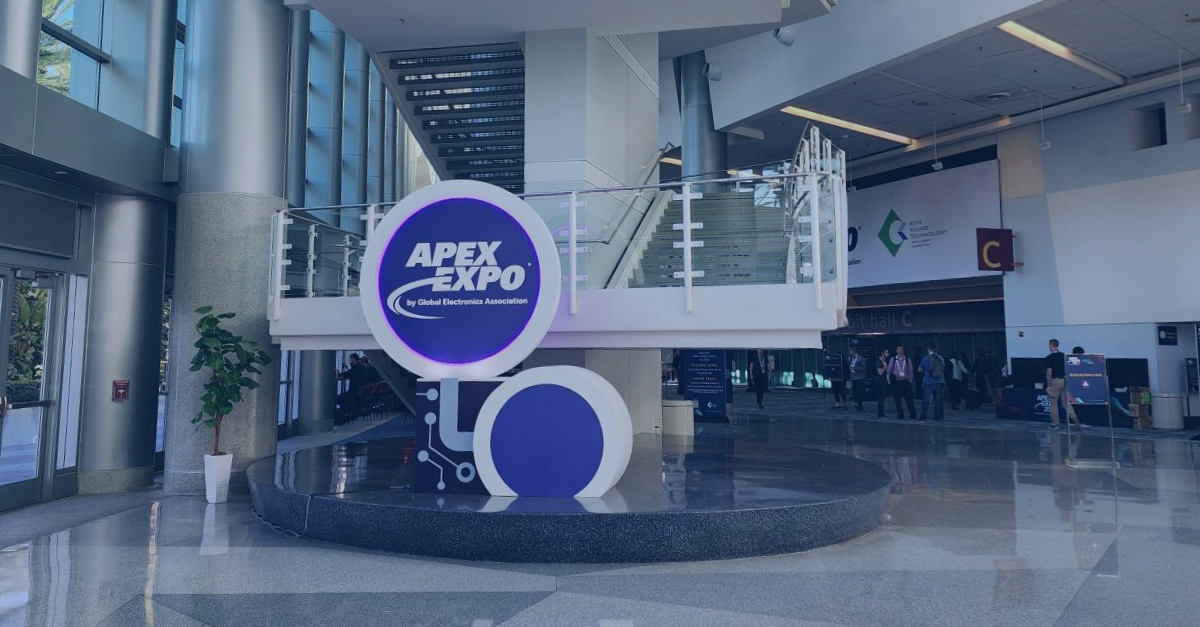
APEX Expo 2026 in Anaheim, California delivered exactly what the electronics manufacturing community needed: energy, investment, and momentum. For Data I/O, it was one of our strongest show appearances in recent memory, marked by meaningful conversations, a prestigious industry award, and growing excitement around where our unified programming platform is headed.

At the show, we showcased the full depth of our unified programming strategy, connecting semiconductor programming from design and NPI through volume production and beyond. Here’s a look at what made the show so memorable.

LumenX2 Earns the 2026 NPI Award for Breakthrough in Electronics Programming

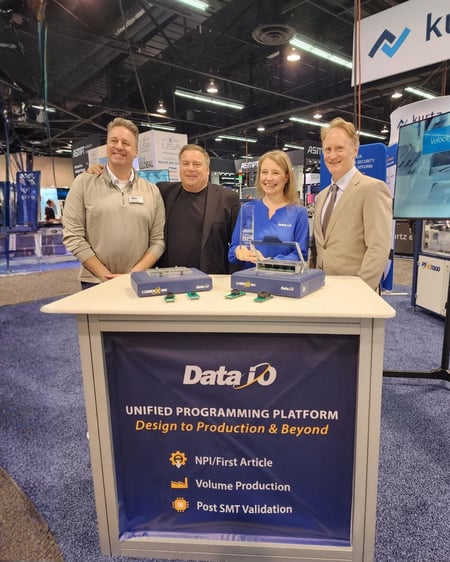
The highlight of the show came during the Circuits Assembly NPI Awards ceremony, where Data I/O was honored with the 2026 NPI Award in the Breakthrough in Electronics category for the LumenX2 platform. The award was presented by Mike Buetow, President of the PCEA (Printed Circuit Engineering Association), and accepted by our team at the show.
Apex Expo NPI Award 01

 (Pictured left to right: Monty Reagan, William Wentworth, Jennifer Higgins, and Mike Buetow, President of the PCEA (Printed Circuit Engineering Association), who presented Data I/O with the recognition at APEX Expo in Anaheim.) 


This recognition is an important validation of what the LumenX2 platform represents: next-generation programming performance designed for today’s most complex device requirements. The platform supports UFS, eMMC, microcontrollers, and secure elements, delivering fast verify speeds and tool-less changeovers that help manufacturers improve quality and reduce cost.

Read the full press release: Data I/O’s LumenX2 Platform Earns 2026 NPI Award for Breakthrough in Electronics Programming

Unified Programming Platform on Display

Throughout the four-day show, visitors experienced the full breadth of our unified programming platform, firsthand how the same programming environment carries validated jobs from engineering and NPI directly into high-volume production without requalification.

Solutions on display included:

  • LumenX2-M4: Next-generation manual programmer with expanded device support and faster programming performance

  • LumenX-M8: Award-winning manual programmer for design and NPI

  • FlashCORE III-M4: Trusted performance and scalability for NPI and preproduction workflows

  • PSV Family: High-speed automated programming systems for volume production, including the PSV7000, delivering flexibility and scalability ideal for programming high-density UFS memory and PSV5000, ideal for low to medium volume applications.

  • ConneX: Software for MES integration, traceability, and process analytics

The conversations at the booth reflected a market in motion. As Bill noted in his interview with What’s New in Electronics, the quality of engagement at the show was higher than ever:

“The conversations have been much more meaningful. You can tell the climate’s changed a little bit, and people are investing again.”


CEO Bill Wentworth on Growth, AI, and What’s Next

On day two of the show, Bill Wentworth sat down with Cliff Saunders of What’s New in Electronics for a candid conversation about Data I/O’s transformation, the broader market climate, and what manufacturers can expect from us in the year ahead.

Bill shared that 2025 was a year of deliberate investment, even when the market slowed. “When things aren’t that busy, you can think through decisions, try them out, and not have a negative effect on the business,” he explained.

That investment extended to internal operations, including a significant push into AI-assisted software development that has accelerated bug resolution and improved productivity across the engineering team.

On the business model side, Bill previewed new service offerings expected to roll out in the coming months, including CapEx-based programming models and contractual revenue structures that give customers greater flexibility.

“That’s always been the game plan: CapEx, services, and programming at test. Those are the three major intersection points for data provisioning,” he said. His outlook for 2026: “This is the year for return to growth. I’m seeing clear line of sight to that.”


Extending the Unified Programming Platform into Security Provisioning

One of the most significant conversations happening at the show and across the industry is how to build security into electronic products from the earliest stages of design, rather than treating it as an afterthought in production.

Our recently announced collaboration with IAR, the global leader in embedded development software tools, directly addresses this need. By combining IAR’s expertise in embedded security definition with Data I/O’s proven semiconductor preprogramming technology, the two companies are delivering a seamless workflow that extends secure provisioning from embedded design all the way through mass production manufacturing.

This integration enables OEMs worldwide to:

  • Design security in from the start with the IAR toolchain, then transfer securely into manufacturing on Data I/O manual and automated systems
  • Move production anywhere in the world securely, with consistent security provisioning across global manufacturing sites
  • Reduce development time through combined algorithm libraries that accelerate device support
  • Maintain complete traceability with ConneX software for device-level tracking throughout the entire security provisioning process

As government regulations and industry standards increasingly mandate robust security measures for electronic products, this partnership fills a critical gap in the unified programming platform story, closing the loop between embedded design and production in a way that minimizes exposure to threat actors and protects intellectual property at every step.


ConneX and the Road Ahead

Conversations at the show also generated real excitement around upcoming developments in our ConneX software platform. ConneX is the connective tissue of the unified programming platform, integrating with factory MES systems to enable real-time monitoring, job management, and end-to-end traceability across every stage of the supply chain.

We’re not ready to share all the details just yet, but a meaningful ConneX release is on the horizon, one that will bring deeper analytics, improved integration capabilities, and enhanced support for the security provisioning workflows we’re building with IAR. Stay tuned.


Thank You, Anaheim

APEX Expo 2026 reinforced something we already believe: the manufacturers who invest in a unified programming platform, one that connects NPI to production, design to security provisioning, and manual to automated workflows, are the ones best positioned to compete in a fast-moving global market.

Thank you to everyone who stopped by, asked sharp questions, and helped make this one of our most engaging shows yet. The energy we felt in Anaheim is driving everything we’re building for the months ahead.

We’d love to continue the conversation.


Ready to See the Unified Programming Platform in Action?

Ready to see the unified programming platform in action? Connect with our team to schedule a demo or consultation and discover how a unified strategy can power your next product launch.

 

Read More
Unlocking Efficiency: The Strategic Value of Offline Programming

Unlocking Efficiency: The Strategic Value of Offline Programming

In electronics manufacturing, speed, quality, and flexibility aren’t just goals; they're essential. As devices become more complex and firmware grows, traditional programming methods are being re-evaluated. One such evolution is the move to an offline programming strategy that’s helping manufacturers around the world overcome bottlenecks and drive efficiency.

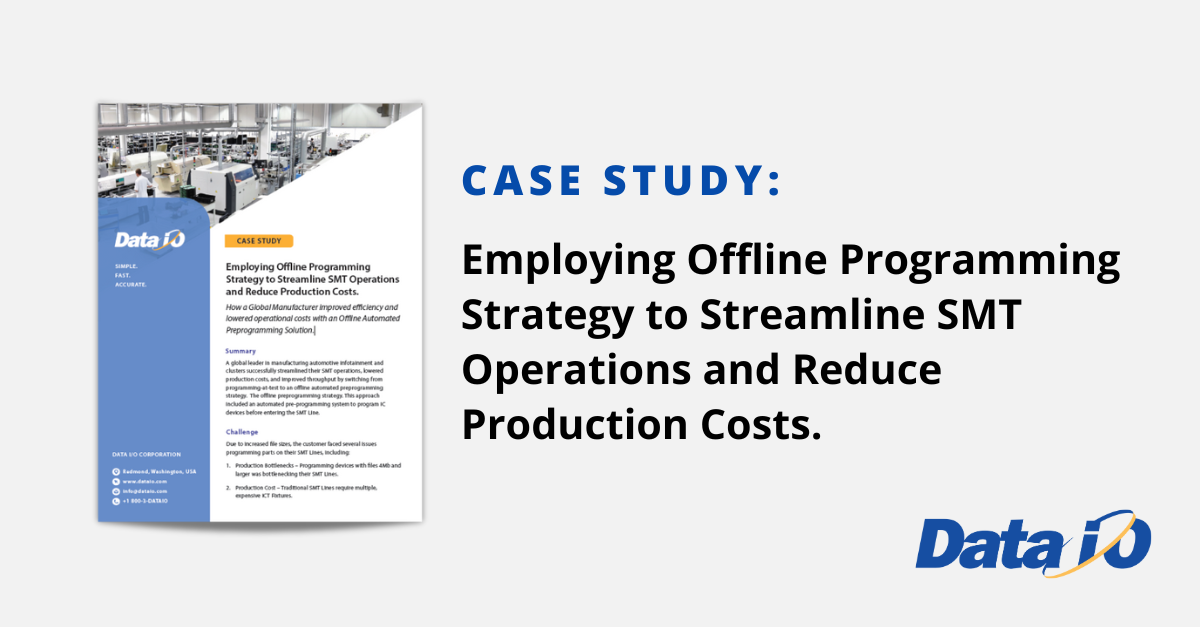
A new case study from a global automotive technology leader shows how shifting from in-circuit test (ICT) programming to Data I/O’s PSV7000 automated offline system eliminated production bottlenecks, enhanced programming reliability, and increased flexibility. You can explore the full case study here.


The Challenge with Onboard Programming

Programming at the ICT or functional test stage has been common in electronics assembly for years, but it's often an unseen source of inefficiency. As firmware sizes grow and security requirements increase, the time required to program a device can exceed the pace of the production line.

This challenge is especially pronounced in industries such as automotive, where traceability, quality, and programming precision are non-negotiable. Delays or failures at the programming stage can result in significant production downtime and inconsistent quality.


Inline vs Offline Programming: A Strategic Choice

Choosing between inline (in-system) and offline programming is not just a technical preference; it’s a strategic decision with operational consequences. Inline programming directly ties programming time to production cycle time. As programming tasks grow more complex, they can throttle throughput.

Offline programming removes this bottleneck. It allows manufacturers to program devices in parallel to production line operations, minimizing downtime and ensuring only pre-validated, programmed devices reach the assembly line. This strengthens quality control and supports scalability.

As Tan Beng Chye notes in Circuit’s Assembly "Programming In-System versus Offline," “ISP tends to extend the test cycle time by up to 200 percent, depending on the size of the code and the interface used. Offline programming eliminates programming from the test process and improves throughput.”


The Role of Automation

Offline programming becomes even more powerful when paired with automated systems like Data I/O’s PSV7000. For the OEM featured in the case study, automation introduced a new level of repeatability, throughput, and precision. It reduced operator error, accelerated production speed, and allowed the company to consolidate programming across multiple product lines with a unified job setup.


Manufacturing Execution Systems and Traceability

Offline programming strategies align well with modern manufacturing execution systems (MES). A strong MES doesn’t just provide traceability—it connects programming with broader manufacturing data. This is critical when validating firmware versions, serializing devices, and ensuring consistent outcomes across production locations.

When integrated with a solution like Data I/O’s ConneX, manufacturers gain real-time visibility into programming job status, analytics, and quality metrics. This integration supports faster root-cause analysis, compliance reporting, and continuous improvement.

When integrated with a solution like Data I/O’s ConneX, manufacturers gain real-time visibility into programming job status, analytics, and quality metrics. This integration supports faster root-cause analysis, compliance reporting, and continuous improvement.


Scalability Without Compromise

What makes the unified programming strategy so powerful is its ability to scale without disruption. A single programming job, validated during NPI, can be used across manual programmers like the LumenX-M8 or FlashCORE III-M4 and scaled seamlessly into automated PSV systems.

This consistency reduces requalification, eliminates duplicate engineering effort, and shortens time-to-market. For organizations managing global production networks or distributed supply chains, a unified programming strategy is a clear competitive advantage.


Access the Full Case Study

To see how one automotive technology leader achieved these results using the PSV7000, download the full case study here.

Learn how the switch to offline programming created new opportunities for efficiency, flexibility, and quality improvement in a high-demand environment.


Case Study Offline Programming Strategy


Read More
Productronica 2025: Programming Innovation on Display

Productronica 2025: Programming Innovation on Display

Reflecting on an Industry Milestone

Productronica 2025 marked another pivotal moment for the global electronics manufacturing community. For Data I/O, it was a celebration of innovation, partnership, and progress. From showcasing our latest solutions at booth A2-205 to winning one prestigious awards, the event underscored our ongoing leadership in device programming and preprogrammed supply chain enablement. 

As William (Bill) Wentworth, President and CEO of Data I/O, shared,

“Winning the 2025 Global Technology Award for LumenX2 is an important validation of how critical next-generation programming technology has become for our industry. With the LumenX2 platform we’re helping our customers improve quality, reduce cost and compete in a fast-moving global market.” 


Live at Booth A2-205: Unified Programming Platform Innovations On Display 

Throughout the show, visitors experienced firsthand the power of our Unified Programming Platform and how they can benefit from the same programming platform in design/NPI with a seamless transition into production.  Live demos included: 

  • NEW LumenX2-M4:  Industry unveiling of Data I/O’s next generation LumenX programming platform providing more power and pins and enabling broader support of device [can you link this to the PR?]

  • LumenX-M8: Our refreshed manual programmer attracted strong attention for its compact footprint, intuitive design, and seamless compatibility with automated PSV systems.

  • FlashCORE III-M4: Highlighted as a trusted solution for NPI and preproduction workflows.

  • PSV7000: Demonstrated high-speed automation, up to 2,000 parts/hour, with fast changeovers and scalable socket capacity. 

  • PSV5000: Provided a closer look at cost-effective automation for growing production needs. 


All systems emphasized our unified approach, validating programming jobs once and scaling them globally with consistent quality. 


Award-Winning Technology: LumenX2 Shines at Productronica 

We were honored to accept the Global Technology Award (Programming Category) for the LumenX2 platform and LumenX2-M4 manual programmer during the show. This recognition highlights our investment in platform scalability and our ability to address today’s most complex device programming requirements, including support for UFS, eMMC, microcontrollers, and secure elements with blazing fast verify speeds and tool-less changeovers. 

Earlier in the season, the LumenX-M8 earned the Mexico Technology Award at the SMTA Guadalajara Expo & Tech Forum in September, further recognizing its importance in helping customers streamline NPI and scale into automated production. Most recently, the LumenX-M8 was also awarded the 2025 Step-by-Step Excellence Award at NEPCON Shenzhen in October, honoring its innovation, ease of use, and contribution to engineering productivity. 


Engaging with Customers and Partners 

According to Monty Reagan in his interview with WNIE,

"The traffic here has been very good. We’ve had existing customers come by that are seeing the new products say, ‘yes, that fills a gap."

The booth buzzed with conversations from longtime customers and new prospects alike. Many visitors shared how their product roadmaps are shifting, and they’re seeking scalable solutions to support product diversification and global deployment. Our growing network of technology partners, many of whom spent significant time at our booth, helped reinforce that we’re supporting the complete lifecycle of preprogrammed parts. 


Leadership Vision: Building for Today and Tomorrow 

In a compelling interview with Global SMT TV, Bill Wentworth and Monty Reagan discussed how Data I/O is investing to bridge industry gaps: 

  • Scalable Automation: Addressing needs of mid-tier manufacturers with flexible, affordable tabletop automation. 

  • Embedded Solutions: Expanding capabilities by embedding programming into final test systems. 

  • Service and Capital Equipment Strategy: Offering programming as a service for customers not ready to invest in capex. 

Bill shared,

“We’re filling the gaps that matter, whether it’s light manufacturing in the U.S. and Europe or embedding programming in test systems. Our customers want flexibility, and we’re delivering it.” 


Customer-Centric to the Core 

As Monty noted,

“We’ve revamped our service organization and are adding tools to give customers better visibility to keep those systems alive and maximize the efficiencies of the equipment.” 

Our Unified Programming Platform ensures customers can confidently design products with the assurance they’ll scale seamlessly into production anywhere in the world. This lifecycle commitment is what’s made Data I/O a trusted partner for decades. 


The Road Ahead 

Productronica 2025 confirmed what we already know: innovation never stops. As we look to 2026, we remain focused on delivering programming solutions that keep pace with device complexity, accelerate time-to-market, and protect customer investments. 

Thank you to everyone who visited our booth, shared feedback, and helped make this year’s show a success. 


Want to see what’s next? 

Schedule a follow-up demo or consultation with our team and discover how a unified programming strategy can power your next product launch. 
 

Read More
Unified Programming Strategy: Simplify, Scale, and Succeed from Design to Production

Unified Programming Strategy: Simplify, Scale, and Succeed from Design to Production

Why Unified Programming Matters

Electronics manufacturing is more complex than ever. As devices become smarter and more connected, programming requirements are growing in volume, complexity, and security. For OEMs and manufacturers in automotive, medical devices, industrial controls, wireless, and consumer electronics, managing programming across design, NPI, and production is increasingly challenging.

A Unified Programming Strategy solves this by standardizing how programming is handled across every stage of the product lifecycle, using one integrated platform. It eliminates redundant effort, reduces risk, and speeds up time-to-market.


What is a Unified Programming Strategy?

A Unified Programming Strategy uses a single ecosystem of hardware, software, and job files across design, new product introduction (NPI), and high-volume production. Instead of separate systems for early-stage validation and factory programming, everything is aligned from day one.

Key components of the strategy include:

  • FlashCORE III-M4 and LumenX-M8 for design and NPI
  • PSV7000, PSV5000, and PSV3500 for automated volume production
  • ConneX for MES connectivity, traceability, and process analytics


Who Should Use a Unified Programming Strategy

A Unified Programming Strategy is best suited for companies seeking to improve quality, efficiency, and time-to-market by eliminating fragmentation in their programming processes. It’s particularly valuable for OEMs and manufacturers managing high-mix production or global operations. In-house engineering teams benefit from job file consistency across design validation and production. Companies with design operations in one region and production in another can seamlessly transfer validated programming jobs without rework. EMS providers and programming centers also benefit from compatibility across all job stages, reducing duplication and increasing customer satisfaction.


Common Challenges a Unified Strategy Solves

Manufacturers often face technical and operational hurdles when programming workflows are disjointed. For example, using different programming platforms for NPI and production often leads to checksum mismatches and costly requalification efforts. Recreating programming jobs manually introduces human error, causing delays and inconsistencies. Outsourced or fragmented programming can result in quality issues due to lack of process alignment. These gaps also disrupt just-in-time manufacturing models when preprogrammed parts arrive late or unvalidated. A Unified Programming Strategy addresses these problems by using a single programming job, algorithm, and adapter ecosystem across every phase.


The Benefits of a Unified Programming Strategy

Implementing a unified approach delivers clear operational and business advantages. It enables a streamlined NPI process where programming jobs are validated once and carried through to high-volume production without modification. This reduces engineering labor, eliminates duplication, and ensures consistent outcomes. Manufacturers experience faster time-to-market because delays caused by requalification or job recreation are eliminated. Costs decrease as fewer errors occur and teams spend less time managing transitions.

According to research published in Information and Management, companies that adopt digital transformation strategies, including standardization and process integration, experience measurable gains in production efficiency, operational agility, and cost savings (Wang et al., 2024).

Real-world use further reinforces these benefits. For example, in the blog Optimizing the NPI Process with a Unified Programming Platform, one OEM reduced requalification time and achieved consistent programming results from engineering through production by adopting a unified programming platform.

With ConneX software, traceability is built in, giving engineering and quality teams access to job-level data across the supply chain. And as production ramps, the same validated programming jobs can scale effortlessly from manual validation to high-volume PSV automation.


How Data I/O Enables a Unified Programming Strategy

Data I/O’s programming solutions are purpose-built to support a unified strategy from start to finish. Our programming technology, FlashCORE III and LumenX, is at the core of our solutions. Our manual and automated programming systems use the same programming technology. The FlashCORE III-M4 and LumenX-M8 manual programmers empower engineering teams to validate jobs at the design stage with the same programming platform technology used in production. For automation, the PSV family of programmers (PSV7000, PSV5000, PSV3500) offers unmatched scalability, performance, and socket density to meet any volume need. ConneX software integrates with factory MES systems, enabling traceability, real-time monitoring, and job management. With global service, device support, and annual support programs, Data I/O ensures your investment is protected and future-ready.


Is Your Programming Strategy Unified?

Use this checklist to evaluate if your current device programming process supports a unified approach from design to production.

  • Are your design/NPI and production teams using the same programming platform?
    Mismatched tools increase job recreation time and risk of checksum errors.
  • Can you validate a job once and use it throughout the product lifecycle?
    Reusing validated jobs across stages saves time and ensures consistency.
  • Do you rely on manual job recreation when transferring to production?
    Manual recreation introduces unnecessary risk. Unified job files eliminate this.
  • Is your programming solution scalable across low to high volumes?
    A unified platform should support both desktop validation and automated production.
  • Do you have built-in traceability and MES integration?
    Tools like ConneX enable real-time tracking, analytics, and job-level traceability.
  • Can you support global production without changing adapters, algorithms, or job files?
    Unified systems reduce requalification and enable seamless global manufacturing.
  • Have you eliminated rework caused by programming inconsistencies?
    Unified programming reduces errors, improves first-pass yield, and ensures quality.

Take the Next Step

If you're ready to optimize your programming process, streamline your supply chain, and improve production outcomes, it’s time to unify.

Start your unified strategy today. Schedule a consultation or demo with our team.


Reference:
Wang, D., Wang, H., Deng, W., & Wu, Y. (2024). Digital transformation and production efficiency: Evidence from manufacturing firms. Information and Management, 61(3). https://www.sciencedirect.com/science/article/pii/S1059056024000467

Read More
Energy, Engagement and Innovation Data I/O at IPC APEX 2025

Energy, Engagement & Innovation at IPC APEX 2025

The IPC APEX Expo 2025 was one for the books. From live demos to deep conversations about production efficiency and programming innovation, this year’s show was by far the most engaging Data I/O has participated in for quite some time.

A sincere thank you to all who stopped by Booth #2723. Whether you saw our unified programming platform in action, watched a demo, or connected with the team, your interest and energy were truly inspiring. We’re carrying that momentum forward as we continue evolving our offerings to support OEMs and electronics manufacturers better better.


Refreshed Manual Programmers Take Center Stage

This year’s show marked the debut of our refreshed manual programmers, designed to support preprogramming needs from design through volume production. Engineered for flexibility, accuracy, and seamless integration, these updates make it easier than ever to validate and transfer programming jobs from NPI into high-volume manufacturing.

When paired with our PSV family of automated systems, these refreshed solutions offer a unified platform experience, streamlining workflows and improving consistency across the entire production lifecycle.


Interview with WNIE: Strategy Meets Innovation

We were thrilled to have Monty Reagan, VP of Global Sales & Marketing, sit down with What’s New in Electronics (WNIE) during the show. In this short interview, Monty shared how Data I/O is streamlining the device programming process—from early design and NPI through production, QC, and repair.

Monty discussed how our unified platform strategy helps manufacturers simplify complex programming challenges and stay competitive in a rapidly evolving electronics landscape. He also shared insights into how we’re leveraging automation and AI to drive efficiency and innovation across the supply chain.


Driving Impact Through a Unified Programming Strategy

Throughout the week, attendees experienced how a unified programming platform can:

✅ Reduce errors with precise, reliable device programming
✅ Improve lead times by streamlining production workflows
✅ Enhance traceability and quality with a fully connected factory

With our integrated solutions—spanning from refreshed manual systems to production-ready PSV platforms—we’re helping electronics manufacturers streamline NPI, reduce delays, and optimize performance from the start.


Looking Ahead

The energy we experienced at IPC APEX 2025 is fueling new ideas and ongoing product development. We’re committed to building on this momentum and delivering even more value to our customers in the months ahead.

If you missed us at the show or want to continue the conversation, we’d love to connect.

Contact Our Sales Team


Read More
Optimizing the NPI Process with a Unified Programming Platform

Optimizing the NPI Process with a Unified Programming Platform

For OEMs, the New Product Introduction (NPI) process is critical in ensuring that new designs are ready for production. A key step in this process is programming the flash memory or microcontroller devices to validate that the firmware or software is correctly written. However, inconsistencies can arise when different programming platforms are used during design, NPI, and production, leading to increased costs, delays, and quality issues.

A global manufacturer of computer products and accessories faced these exact challenges. Their NPI workflow relied on a different programming supplier for design, test, and validation before transitioning to a Data I/O automated programming system for volume production. This mismatch in platforms led to inefficiencies, requiring additional requalification time and increasing the risk of programming errors.

Download the full case study to see how this OEM overcame these challenges with a unified programming platform.


The Risks of Using Different Programming Platforms

Using different programming solutions during NPI and production creates several challenges:

  • Inconsistent Programming Results – Proprietary algorithms from different vendors can lead to mismatched checksums and failed verifications.
  • Increased Human Error – Recreating programming jobs from scratch for production increases the chance of mistakes.
  • Higher Costs – Different programming platforms require separate adapters, adding unnecessary expense.
  • Delays in Production – Algorithm requalification slows down the transition from NPI to volume manufacturing.

For manufacturers striving for efficiency, these challenges can disrupt timelines, add costs, and impact overall product quality.


A Unified Solution for Seamless NPI to Production

To address these inefficiencies, the OEM implemented Data I/O’s FlashCORE manual programmer for NPI, aligning it with their existing PSV3500 automated programming system used in volume production. This shift to a unified programming platform allowed them to:

  • Seamlessly transfer validated programming jobs from engineering to production.
  • Eliminate algorithm requalification between different programming suppliers.
  • Use shared socket adapters across design, NPI, and production phases.

By integrating a single programming platform from the start, the OEM optimized their NPI workflow and removed barriers to efficient production.


Measurable Results: Improved Efficiency and Quality

By adopting a unified programming platform, the OEM achieved:

  • Increased Efficiency – Reduced requalification and failure analysis time.
  • Improved Quality – Consistent programming results from engineering through production.
  • Supply Chain Optimization – Standardized programming across the entire product lifecycle.

This transformation enabled the manufacturer to accelerate their NPI process, reduce production delays, and improve overall manufacturing reliability.


Download the Full Case Study

Ready to streamline your NPI process and boost manufacturing efficiency?

Download the full case study to discover how a unified programming platform transformed a global OEM’s operations and how it can drive similar results for your business.


Read More

Overcoming Semiconductor Supply Chain Challenges

The semiconductor supply chain is a cornerstone of modern electronics manufacturing, but it’s not without its challenges. For many original equipment manufacturers (OEMs) and electronics manufacturers, supply chain inefficiencies like errors in preprogrammed parts and long lead times can disrupt operations and derail Just-in-Time (JIT) manufacturing goals. These issues create ripple effects across production lines, driving up costs and threatening quality.

For OEMs navigating these challenges, a unified preprogramming platform offers a transformative solution.


The Challenges OEMs Face

The semiconductor supply chain is inherently complex, requiring precision and reliability at every stage. Yet, many OEMs find themselves grappling with:

  • Errors in preprogrammed parts from outside providers: Inconsistent programming leads to compatibility issues and downstream disruptions.
  • Frequent Code Changes: software changes during the development to NPI and volume production can lead to delays and rework in manufacturing.
  • Inconsistent quality from suppliers: Relying on external vendors often results in varying standards that impact production.
  • Long lead times: Delays in receiving preprogrammed devices can throw off JIT schedules, increasing inventory costs and affecting delivery timelines.

These challenges don’t just affect manufacturing efficiency; they can erode customer trust, compromise competitiveness and time to market. Addressing them is essential for any OEM striving to meet high standards of quality and speed.


The Power of a Unified Preprogramming Platform

What if you could streamline your supply chain with a single, cohesive preprogramming solution that works in each stage of your semiconductor preprogramming supply chain? A unified preprogramming platform provides that opportunity, enabling OEMs to:

  • Validate programming early: By integrating manual programming systems into the design process, engineers can catch issues before they escalate and trust that the programming results will be consistent and reliable during NPI and volume production.
  • Achieve seamless transitions: A unified programming platform ensures programming jobs are seamlessly transferred from First Article validation to volume production without disruption.
  • Gain supply chain control: In-house preprogramming reduces reliance on external vendors, ensuring consistent quality and faster turnaround times.

A robust platform not only addresses immediate inefficiencies but also positions OEMs for long-term success, allowing them to adapt to future demands with confidence.


A Real-World Transformation

An OEM who is a global leader in access control faced significant challenges with their outsourced preprogramming supply chain, including frequent errors and lead time delays that undermined their JIT manufacturing goals. By partnering with Data I/O, they implemented a unified preprogramming platform that:

  • Reduced errors through early validation during the design and engineering phases.
  • Improved lead times by transitioning preprogramming in-house, reducing dependency on external suppliers.
  • Streamlined operations across the supply chain, from design validation to post-production rework.

The results were transformative, enabling them to align their processes with JIT principles and build greater confidence in their supply chain.

To learn more about this OEM’s journey and how they achieved these results, download our full case study.


Optimize Your Supply Chain

For OEMs striving to overcome supply chain challenges, a unified preprogramming platform can make all the difference. By reducing errors, improving lead times, and streamlining operations, this approach empowers manufacturers to achieve their goals without compromise.


Want to learn how to optimize your supply chain and enhance manufacturing efficiency?

Download our case study to discover how a unified preprogramming platform transformed a global OEM’s operations and how it can do the same for you.


Read More

Evolving for the Future: A Conversation with Singular Research

At Data I/O Corporation, we pride ourselves on being a global leader in programming and security deployment systems. Recently, CEO Bill Wentworth participated in a Singular Research investor conference to share the company’s vision for innovation, market expansion, and leveraging its rich legacy to navigate the complexities of today’s technology landscape.


A Legacy of Innovation

Since its founding in 1972, Data I/O has built a strong reputation in the semiconductor industry. The company’s proprietary programming language and platform are vital in embedding data and intellectual property into semiconductors. With global operations in Redmond, Munich, and Shanghai, Data I/O continues to deliver innovative solutions to a diverse and worldwide customer base.

“Our goal is to get back to our roots and leverage our legacy brand while advancing into new markets and technologies,” said Bill Wentworth.

This focus on heritage and progress is a cornerstone of the company’s mission.


Leadership Driving Change

Under the guidance of new CEO Bill Wentworth, Data I/O is entering a transformative phase of growth. Bill’s leadership emphasizes diversifying revenue streams and expanding the company’s market reach. Meanwhile, CFO Gerry Ng continues to prioritize financial health and sustainability to support long-term innovation efforts.

“By diversifying our revenue streams, we aim to maintain stability even during market fluctuations,” added Wentworth.


Market Diversification: Building Resilience

While the automotive sector remains a core market for Data I/O, the company is actively expanding into service provider networks, franchise and non-franchise distribution, and contract manufacturing. These initiatives help mitigate risks associated with industry-specific downturns.

By targeting service providers, Data I/O is tapping into a customer base that spans multiple industries.

“This approach creates a buffer against reliance on a single market and broadens our revenue pillars,” explained Wentworth.


Advancing Technology with LumenX

The transition from the FlashCORE III platform to the advanced LumenX platform is a significant step forward. This shift enhances technological capabilities and positions the company to address evolving industry needs. Expanding the device library and embedding solutions deeper into the supply chain are central to this transition.

“Reengaging with engineering communities in the U.S. and Europe is pivotal for our growth,” Wentworth noted.

Through these collaborations, Data I/O aims to remain at the forefront of technological advancements.


Tackling Geopolitical and Financial Challenges

As a global company, Data I/O recognizes the need to navigate geopolitical challenges strategically. By reinforcing its Redmond headquarters as a center of excellence, the company is preserving and leveraging the knowledge and expertise built over 50 years.

“It’s essential to preserve and leverage the legacy knowledge built over 50 years to drive thought leadership in our technology and products,” said Wentworth.

CFO Gerry Ng highlighted the company’s financial strength, including a robust cash position and balanced revenue streams. These factors enable strategic investments while maintaining financial stability.


Conclusion

Data I/O remains committed to honoring its legacy while embracing innovation. By diversifying markets, advancing technology, and addressing global challenges, the company is poised to lead in the ever-evolving semiconductor industry.

Stay connected to see how Data I/O continues to innovate and expand its impact in the global technology landscape.


Read More
Officers and Leadership from Data I/O stand behind the podium at NASDAQ New York ringing the closing bell

Data I/O Rings the NASDAQ Closing Bell: A Celebration of Innovation and Legacy

On October 28, 2024, Data I/O (NASDAQ: DAIO) celebrated a monumental milestone—ringing the NASDAQ Closing Bell at the MarketSite in Times Square, New York. The event marked not only a significant moment for the company but also a reflection of its longstanding commitment to leadership, quality, and continuous innovation in the electronics manufacturing industry.

Screenshot 2024-10-28 130057

A Legacy of Excellence

For over five decades, Data I/O has been the global leader of data programming solutions for semiconductor devices. Founded in 1972, the company pioneered the first programming solution and has consistently delivered innovative solutions for programming microcontrollers, security ICs, and memory devices. This achievement is particularly noteworthy given the rapid pace of change in the technology and electronics industries, yet Data I/O has remained a constant, trusted partner for its clients in sectors ranging from electronics manufacturing services (EMS) to automotive and other OEMs.

Since becoming publicly traded on NASDAQ in 1981, Data I/O has positioned itself as a leader in advanced data programming, offering products and services that are essential for the manufacturing of everyday electronic products. With a relentless focus on quality and a deep commitment to innovation, Data I/O has developed solutions that help bring to life the technology we rely on every day.


A Special Moment at NASDAQ

The closing bell ceremony on October 28th was an opportunity for the entire Data I/O team to reflect on the journey that has led to this exciting moment. Bill Wentworth, the President and CEO of Data I/O, had the honor of ringing the bell, symbolizing the company’s leadership in the industry and its ongoing dedication to excellence.

During the event, Bill was also interviewed for NASDAQ’s Behind the Bell series, providing a deeper insight into Data I/O’s journey, its core values, and the future of the company. The interview captures the essence of what makes Data I/O a leader in the field—its commitment to its customers, partners, and employees, as well as its unwavering pursuit of innovation. You can watch the full interview in the video below.

A Tradition of Innovation

Data I/O’s participation in the NASDAQ Closing Bell ceremony is not just a celebration of a single event, but a recognition of the company’s years of dedication and forward-thinking innovation. The company’s success in secure data programming, particularly in sectors like microcontrollers and memory devices, highlights its ability to adapt and evolve in a rapidly changing market. What began as a small company in 1972 has grown to become a key player in the electronics manufacturing supply chain, providing essential solutions for programming and securing data in an ever-expanding digital world.

As the company looks to the future, it continues to focus on the core values that have helped it succeed: trust, quality, and innovation. Whether working with programming service providers, EMS, automotive manufacturers, or other OEMs, Data I/O remains committed to providing the highest level of service and solutions to its customers, ensuring that the world’s electronic devices continue to operate securely and efficiently.


A Moment of Reflection

The NASDAQ Closing Bell ceremony was a moment of pride for Data I/O, as the team celebrated not only this milestone but the years of hard work, collaboration, and dedication that have contributed to the company’s success. From its origins in 1972 to its public debut in 1981, Data I/O has always remained focused on delivering the best solutions to its customers.

We would like to extend a heartfelt thank you to our customers, partners, suppliers, investors, and team members who have played an integral role in Data I/O’s journey. Together, we’ve achieved incredible success, and we’re excited to continue our work with all of you to deliver new, cutting-edge solutions to the global market.

Media (2)-1

Join Us in Celebrating

As we reflect on this incredible moment, we invite you to take a closer look at the event and watch the Behind the Bell video featuring Bill Wentworth. We’re grateful for the opportunity to share this achievement with our team, customers, and partners.

Thank you for being a part of our journey, and we look forward to many more years of growth, innovation, and collaboration.


Read More

Oven Reflow Best Practices for Modern Memory Devices

As memory technologies advance and reflow processes in PCB manufacturing grow more complex, manufacturers face critical questions about maintaining data integrity and performance in pre-programmed devices. Shrinking process geometries and rising reflow temperatures make devices increasingly susceptible to performance degradation, especially with the shift from MLC (Multi-Level Cell) to TLC (Triple-Level Cell) memory devices.

At Data I/O, we’ve long established that pre-programming is safe for MLC devices. But with the adoption of 3D TLC UFS (Universal Flash Storage), how do these devices handle the thermal stresses of reflow? To answer these questions, we partnered with a leading UFS memory vendor to study the impact of reflow processes on pre-programmed devices.


Key Questions Addressed

  1. Will there still be an acceptable margin through reflow as vendors move from MLC to TLC devices?
  2. Does pre-programming affect the lifetime or reliability of TLC devices?
  3. What best practices should manufacturers follow for the newest generation of memory devices?


Our Findings

The experiment focused on 3D TLC UFS devices from multiple semiconductor vendors and evaluated the thermal impact of reflow on device performance and reliability. Here’s what we learned:

  • Reflow slows down read performance but does not cause reliability failures.

  • Multiple reflows (up to 3) are possible without data loss.

  • Refreshing the device after reflow completely restores read performance.

These findings confirm that pre-programming TLC devices is safe and that manufacturers can maintain high-quality performance by following simple post-reflow best practices.


Best Practices for Oven Reflow with TLC Memory Devices

Based on our findings, here are the recommended best practices for ensuring optimal performance through reflow processes:

  1. Perform a Post-Reflow Refresh:
    After reflow, refresh the device to fully restore read performance. This step is critical for maintaining data integrity and achieving maximum device efficiency.

  2. Limit the Number of Reflows:
    Limit reflow cycles to three or fewer to avoid unnecessary thermal stress on the device.

  3. Collaborate with Trusted Vendors:
    Work with semiconductor vendors and programming solution providers like Data I/O to adopt guidelines specifically designed for advanced memory technologies


Get the Full Guidelines

Interested in the full "Recommended Best Practices, X-Ray & Post-Oven Reflow" document? Submit the form below to download this valuable resource, which includes step-by-step guidelines for achieving optimal device performance.


Why It Matters for Electronics Manufacturers

As flash memory usage continues to grow, manufacturers are increasingly reliant on pre-programmed devices for mission-critical applications like ADAS, infotainment, and connectivity systems. Ensuring that these devices perform reliably through reflow processes is essential for quality and safety.

At Data I/O, we’re committed to helping manufacturers navigate these challenges by providing proven programming solutions, collaborating with industry leaders, and establishing best practices for advanced memory technologies.


Download the Recommended Best Practices Document Now
Submit the form above or contact our team to learn more about how we can support your programming needs.


Read More
Highlights from IPC Apex Expo 2024

Highlights from IPC APEX Expo 2024

The Data I/O team recently participated in the IPC APEX Expo 2024, where we showcased our latest innovations in automated device programming systems and security provisioning platforms celebrated our 500th PSV system sold. We want to thank everyone who stopped by our booth to explore our offerings and engage in insightful conversations.


Booth Happenings

A group of professionals gather around a booth at a tradeshowData I/O showcased our industry leading programming technology that addresses industry 4.0 integration capabilities. Attendees learned why Data I/O is the industry leader for device programming and had the opportunity to explore the following products:

PSV Family Automated Device Programming Systems: Featuring the flagship PSV7000 model, and the entry-level option, the PSV3500. These systems offer advanced capabilities for high-performance and configurable device programming.

SentriX Security Provisioning Platform: Simplifying security for mass production with pre-configured deployment profiles. Attendees learned about how SentriX can simplify security provisioning using SentriX Product Creator.

ConneX  Service Software: Enable two-way integration between Data I/O's device programming systems and a factory MES system connected factories to enhance traceability, process analysis, and communication for improved efficiency and quality.

LumenX with VerifyBoost for ultra-fast UFS programming performance with up to 750 MB/sec read and 160 MB/sec write.


Global SMT TV Interview

During an interview with Trevor Galbraith from Global SMT & Packaging, Anthony Ambrose, CEO of Data I/O, shared his insights into the company's showcased equipment and market perspectives.

Ambrose highlighted, "We're showing our PSV7000 model, our flagship product, and our PSV3500, which is more entry-level for customers new to volume manufacturing." He also expressed pride in Data I/O reaching a significant milestone, stating, "We've announced our 500th PSV unit sold globally." Watch the full interview (7 minutes) below.


Panel Debate on ESG and Sustainability

Anthony Ambrose participated in a panel debate titled "ESG and sustainability in an EMS world," hosted by Trevor Galbraith. Alongside other industry experts, Ambrose discussed pressing issues surrounding ESG and sustainability in electronics manufacturing.

He emphasized Data I/O's commitment to ESG initiatives, stating, "For us, we've tried to meld the requirements of regulatory compliance and what customers demand so we can create one report that satisfies both needs."

Moreover, Ambrose highlighted Data I/O's efforts toward achieving net-zero emissions. "We're going effectively net-zero worldwide. We buy green power, we have carbon offsets for the natural gas, and we've gone to a policy of only electric or hybrid vehicles for company cars."

Ambrose’s insights provided valuable perspectives on the challenges and opportunities surrounding ESG practices in the manufacturing industry. Watch the entire panel discussion (10 minutes) below.


Data I/O's participation at IPC APEX Expo 2024 showcased its dedication to innovation and excellence in electronics manufacturing. The event provided a platform to engage with industry leaders, share insights, and demonstrate cutting-edge solutions.

Stay tuned for more updates and insights from Data I/O as we continue to drive advancements in automated device programming and security provisioning.


Contact our sales team to discover how our innovations can elevate your manufacturing processes.


Read More

Insights from productronica 2023

productronica 2023, the industry’s largest conference and exhibition for electronics manufacturing, happens every two years in Munich, Germany. We are thrilled to share the latest updates from our recent appearance at the show. This event presented us with a tremendous opportunity to showcase our cutting-edge solutions and engage in insightful discussions on the future of electronics manufacturing. 


During the event, Data I/O President and CEO, Anthony Ambrose, actively contributed to the industry dialogue furthering the discussion on topics including environmental, social, and governance (ESG) performance for electronics manufacturers, the importance of securing IoT devices during the device programming process, and the role of device programming in the future of smart factories.  


Anthony Ambrose also presented at the productronica Forum during the event, “Simplifying Hardware-based IoT Security in the Electronics Supply Chain with Pre-defined Use Cases”, and "Industry 4.0: Integrating Offline Automated Device Programming into the Connected Factory for Production Efficiency, Traceability and Quality.” The latter topic sparked interest from IoT Insider, who scheduled time for a follow-up interview to explore the topic of Industry 4.0 and how device programming is going to be a strategic part of any smart factory to increase manufacturing efficiencies in production and traceability throughout the supply chain.  


Also announced at the event were the winners of the 2023 Global Technology Awards, an 18-year-running award ceremony hosted by Global SMT & Packaging. This celebration recognizes the companies and people achieving standards of excellence and driving the printed circuit assembly and packaging industries forward.  Data I/O was honored to receive the Device Programming Award for VerifyBoost™ for Lumen®X. 


As we delve into thought leadership at productronica 2023, the narrative continues to unfold. Data I/O’s role in shaping industry dialogues sets the stage for the dynamic conversations and impactful insights that emerged at this premier electronics manufacturing event. 


Industry Thought Leadership Discussions from productronica 

At the forefront of innovation and thought leadership, Data I/O, led by our CEO, Anthony Ambrose, actively participated in pivotal discussions at productronica 2023. As we explore the challenges and advancements in our field, these dialogues not only underscore Data I/O's dedication to excellence but also emphasize the collective mission of industry leaders—to propel our shared vision forward and drive meaningful change in the landscape of electronics manufacturing. 


Image of a panel discussion taken during productronica 2023Likely the most buzz-worthy topic at this year’s productronica show was the topic of ESG and sustainability. Trevor Galbraith of Global SMT and Packaging hosted a panel discussion on the topic and invited Mr. Ambrose to participate, along with other industry leaders. This engaging conversation shed light on the challenges electronics manufacturers face in improving ESG performance and promoting sustainability within supply chains. 


Trevor Galbraith of Global SMT speaks to Anthony Ambrose of Data I/O during productronica 2023In a brief yet insightful interview with Global SMT and Packaging, Mr. Ambrose also shared how customer needs influenced recent upgrades to our ConneX and VerifyBoost™ platforms. Jennifer Higgins, our Director of Corporate Marketing, provided valuable insights into Data I/O's ESG and sustainability strategy. We encourage you to explore the interview to gain further insights. Data I/O Upgrades ConneX and VerifyBoost™ Platforms (duration: 9 min.). 


Chloe O'Brien of WNIE speaks with Anthony Ambrose of Data I/O during productronica 2023Mr. Ambrose engaged in discussions with What's New in Electronics (WNIE) on secure device programming solutions with SentriX® and smart factory automation with ConneX. These conversations highlighted the importance of our solutions in ensuring secure programming and driving the future of smart factories. Data I/O on Secure Device Programming and Smart Factory Automation (duration: 5 min.). 


Anthony Ambrose, CEO of Data I/O speaks during a forum presentation at Productronica 2023IoT Insider also published an article about Mr. Ambrose’s forum presentation on Industry 4.0, emphasizing the integral role of device programming in the future of smart factories. The article underscores our commitment to shaping the industry's future. Device programming is integral to the future of smart factories (5-min. read). 


In wrapping up our experience at productronica 2023, we want to express our gratitude for the enriching discussions and exciting developments occurring during the event. The industry's recognition, exemplified by winning the 2023 Global Technology Award for the Device Programming category, fuels our commitment to excellence. 

The buzz generated at productronica echoes our mission — to bring electronic products to life, ensuring efficiency, security, and sustainability at every step. We are excited about the path ahead and look forward to sharing more updates and innovations as we continue to lead in device programming and security provisioning technology in the dynamic world of electronics manufacturing. 


Read More

Planet MicroCap: Device Programming and Security Provisioning for Manufactured Products

Data I/O’s President and CEO, Anthony Ambrose, was a recent guest on the Due Diligence podcast produced by Planet MicroCap and hosted by Robert Kraft, Planet MicroCap founder and Director of Research at SNN Incorporated. Kraft has interviewed hundreds of microcap industry experts, CEOs and investors discussing topics such as microcap investing strategies, market trends, and industry insights. In this conversation, Anthony explains the business of Data I/O for everyday non-high-tech investors and further discusses Data I/O’s role in automotive electronics growth.

Kraft and Ambrose discuss the history and evolution of the company, which was founded in 1972 by several pioneers who invented the device programming category. Over the decades, the company has undergone three significant evolutions, becoming more sophisticated around factory automation, factory control, and automation. The conversation also touches on the importance of programming and its integration into the smart factory concept.

Ambrose explains that the company works with the most complicated systems in the world and needs credibility in all technology vectors to be successful. Despite being a small company, they are experiencing growth in the automotive industry and have 50 tier-one customers worldwide. They discuss the growth of the industry, with the semiconductor content growing at a rate of 12% a year for a decade, and the market is expected to triple in a 10-year period, which is exciting for the company. They also mention that the supply chain mess and shortages in the industry are coming to an end.

The conversation also discusses the challenges faced during the pandemic, the company's ability to weather market volatility, and the different solutions and services offered by Data I/O. Additionally, they mention the importance of the automotive market as a significant revenue stream for the company.

The business model of Data I/O is structured to have scale and support for automotive customers. They go after the higher end of the market and focus on high-end industrial because it is similar to automotive. The company is focused on being the R&D leader and providing new capabilities to the market. The conversation touches on balancing capital allocation, R&D, and sales.

The conversation concludes with the announcement of the company's latest technology, the SentriX security provisioning platform. Data I/O's SentriX platform offers a suite of integrated hardware and software solutions that enable secure and efficient programming and provisioning of IoT devices. The platform is designed to enable a more flexible and scalable approach to device programming and provisioning, helping manufacturers to streamline their production processes and reduce costs


Topic Overview:

    • Introduction of Anthony Ambrose, President and CEO of Data I/O

    • Explanation of Data I/O's business for non-high-tech investors

    • History and evolution of Data I/O

    • Importance of programming and integration into smart factory concept

    • Growth of the automotive electronics industry and its significance for Data I/O

    • Challenges faced during the pandemic and ability to weather market volatility

    • Solutions and services Data I/O offers

    • Business model for Data I/O, focusing on high-end industrial and being the R&D leader

    • The SentriX platform and its benefits for manufacturers

    • Vision for the next 3-5 years


Planet MicroCap’s Profiled Companies: Q & A with Anthony Ambrose

In the interview, Anthony Ambrose discusses Data I/O’s strong performance in 2022, its growth prospects, and industry tailwinds, including the projected growth in the automotive electronics market. Ambrose also talks about the company's new product announcements, including VerifyBoost, a patent-pending technology that improves UFS memory programming times by speeding up the verification portion of the programming cycle by 4.5x. 

Click HERE or the image below to read the full article. Planet MicroCap article graphic 3


Read More

2023 Embedded World Exhibition & Conference

The Embedded World Exhibition and Conference is held in Nuremberg, Germany, and is considered one of the largest and most important trade fairs for embedded technology in the world. The exhibition provides a platform for companies and organizations to showcase their latest innovations, products, and services in the field of embedded systems. The conference, which runs parallel to the exhibition, features expert presentations, workshops, and panel discussions on various topics related to embedded systems technology. Attendees can learn about the latest trends, best practices, and emerging technologies in the field.


Data I/O has been participating in this event for several years, showcasing the latest in security provisioning and data programming solutions. This year, attendees were able to see how Data I/O is simplifying IoT security with in-booth demonstrations of the SentriX Security Deployment Platform.  During the expo, Data I/O held a forum presentation on the simplification of IoT security, was featured in an executive interview with Embedded Computing & Design and, even took part in a live-stream booth tour courtesy of Nicolas (Charbax) Charbonnier. 


Read on to watch the following video interviews and presentations. 


Data I/O Booth Tour

Relive the moment, or visit for the first time by taking a tour of the Data I/O booth thanks to Nicolas (Charbax) Charbonnier who stopped by to chat with Data I/O CEO and President, Anthony Ambrose during the show. This 16-minute video gives a clear overview of how Data I/O is approaching security provisioning with the SentriX Platform and PSV data programming solutions.


Forum Presentation: Simplifying Hardware-Based IoT Security in the Electronics Supply Chain with Pre-Defined Use Cases

Rajeev Gulati, Data I/O Vice President and CTO, spoke on the need for simplified security deployment in the electronics supply chain during an exhibitor’s forum during the event. Forum Description: Enterprises and consumer electronics OEMs (Original Equipment Manufacturers) deploying IoT devices need easy-to-use systems to protect intellectual property, simplify their supply chains, and protect the data and privacy of their users. An integrated production system comprising security provisioning and simplified tools reduces the complexity of deploying hardware-based security from design to manufacturing. Pre-defined security use cases enable efficient deployment of IoT security into mass production-connected products.


Embedded Executives Interview with Embedded Computing & Design

During the expo Anthony Ambrose, Data I/O CEO and President, and Rich Nass from Embedded Computing and Design met to discuss the latest developments in IoT security and Data I/O’s role in leading device security implementation.

“Having security to protect your firmware, protect your data stream, is really what enables you to monetize the data that you're going to get when you make intelligent IoT in a factory." Anthony Ambrose


Thank you to all who attended the Embedded World Exhibition and Conference in Nuremberg, Germany, and stopped by Data I/O's booth.  We were delighted to participate in the event once again this year and showcase our latest security provisioning solutions and discuss with customers how we can help them define, manufacture and deploy secure IoT products.  If you missed the expo and would like to talk with a local representative about our products and services, please reach out via this request form. 

We look forward to seeing you again next year in Nuremberg!


Read More
Data I/O positioning for growth 2022

How Data I/O is Positioning to Capitalize on Industry Trends

Data I/O, the leading global provider of advanced data programming and security provisioning solutions for flash-memory and microcontroller devices, emerged from 2021 stronger, more resilient and well-positioned to support growing demand driven in automotive electronics, security and the connected factory.

Throughout the pandemic, Data I/O focused on supporting our global customers and keeping our employees, their families and the factory safe. Over 90% of our employees are vaccinated without the need for a mandate. We developed innovative methods to support our global customers with modern tools that enable remote support and remote system installation.

In addition, we leveraged our manufacturing locations in Redmond, WA USA and Shanghai, China to develop a resilient supply chain where we can build and ship product from either location. This strategy was critical to the company maintaining delivery times while we experienced an 85% Year-over-Year growth on bookings in the first half of 2021.

In 2021 the company continued to invest and release new programming solutions to address three major industry trends that impact programming requirements:

  • Growth in double-digit growth projected over the next ten years in automotive electronics content driven by electrification, enhanced safety and added capability to the dashboard and infotainment
  • Security provisioning for industrial IoT and automotive applications and
  • Connected factory for enhanced traceability, quality and analytics

Automotive

Over the next ten years, IHS predicts close to 12% CAGR growth in the automotive semiconductor market. We are seeing increased silicon content in Advanced Driver Assist System (ADAS), also known as Active Safety. These systems are being widely deployed across all classes of cars and significantly increase silicon and programmable content. This includes sensors and very large amounts of FLASH memory.

File sizes in each device programmed are getting larger and more complex. This is especially true in the infotainment market, where hundreds of Gigabytes of NAND FLASH memory are used. To support this growth these applications are transitioning from eMMC Flash Memory to Universal Flash Storage (UFS).

Data I/O responded with the development of its UFS interface for the PSV programming systems. We are well ahead of the curve as eMMC, the incumbent interface, still dominates the landscape but UFS is the chosen next generation. Data I/O is the leading global supplier to the automotive market with support for 17 of the top 21 tier 1 automotive suppliers. With over 38 automotive wins for UFS, Data I/O ensures our customers programming systems are ready to program UFS with maximum throughput.

Security

Across the automotive and industrial space is the growing demand to protect supply chains and protect firmware intellectual property with strong hardware-based roots-of-trust. We are continuing to see additional security requirements come to us in the automotive and industrial markets.

In 2021 Data I/O launched the award winning SentriX Product Creator, an integrated tool suite designed to simplify the support for security use cases and streamline the transition into manufacturing. With the ability to upgrade over 370 exiting PSV family systems in the field, Data I/O customers can easily scale production to support security provisioning. We expect to see growth in the adoption of our SentriX Security Deployment Platform in 2022.

Powered by strong technical team with deep embedded and security engineering experience, long-standing partnerships throughout the ecosystem and patent-protected technology, Data I/O uniquely qualified to work with OEMs embedded design teams, silicon partners and their manufacturing locations to enable security provision from design through manufacturing.

Connected Factory / Industry 4.0

Data I/O is seeing increased demand for connectivity of programming systems to factory manufacturing execution systems (MES) supporting the Industry 4.0 vision. Ten years ago, programming was a separate activity from the SMT lines, and was often a manual process. The next step was automation of the process using robotic handlers. Connecting automated programming systems into the factory to improve quality control, traceability, factory planning and analytics completes the Industry 4.0 vision.

In November 2021 Data I/O showcased the latest ConneX software. ConneX integrates inputs and outputs between Data I/O’s PSV programming system and a connected electronics manufacturing facility to enable traceability, process analysis and two-way communication that improves factory efficiency and quality. ConneX enables inventory management with job and media validation, improve operator efficiency and quality with job commands sent between MES and a PSV system,  and data capture to enable device traceability, root-cause, post process analysis and security provisioning reporting.

In 2022, we will maintain our focus on safety and resiliency while we deliver the latest innovations in security, and automation for the global automotive and industrial markets.


Data IO - 3 Industry Trends FINAL


Read More

Reduce programming costs & optimize production

In today’s production environment, electronics manufacturers are challenged to reduce costs and optimize throughput to meet production demands. New flash and microcontroller technologies are driving additional device programming requirements in manufacturing. Device programming is an essential process that can directly impact cost and production output. How can electronics manufacturers get the most out of their device programming process while ensuring their investment is protected to meet future demands?


There are various device programming methods used in manufacturing. These methods include manual programming, automated programming, programming at test, programming at the end-of-line and outsourcing. It is not uncommon for a seemingly lower cost solution such as a manual process to be more costly than an automated programming solution. The key is to understand how much it costs to program each device to get a total cost of programming metric. Three key factors that impact the total cost of programming include:

  • Performance: How many devices can be programmed per hour? What is the performance of the programming technology? Today you may be programming microcontrollers and NAND devices which are limited by the write/read speeds of the device. Tomorrow you may need to program devices with faster write/read/write speeds such as eMMC and Universal Flash Storage (UFS). Will the programming technology your investing in be able to keep up maximizing your throughput?

  • Flexibility & Scalability: Device programming requirements are constantly changing with the latest semiconductor technology. These new devices are designed into the latest electronic products utilizing, new Flash memory interfaces, faster write/read speeds and complex security features. In addition, device sizes are shrinking, image file sizes are growing and write/read speeds of the devices are increasing. A programming process that is highly flexible and scalable greatly reduces the total cost of programming.

    As image file sizes grow the time it takes to program each device takes longer reducing production throughput. In this scenario the two ways to improve production throughput is to either purchase an additional programming system or increase the socket capacity in your existing solution. Adding additional programming site(s) to your existing solution greatly reduces your total cost of programming. When evaluating programming methods, it is important to understand what the maximum number of devices the system can support and how you can scale your process to meet your future production demands.

  • Quality & Reliability: Quality and reliability have a direct impact on the total cost of programming. Systems that can deliver high programming yield reduce programming costs associated with rework and improve manufacturing efficiencies. This becomes more important when programming small devices, WLCSP or leaded packages. Programming methods with precision handling, placement accuracy and vision inspection reduce costs associated with damaged or incorrectly programmed devices.


The industry standard for device programming

Data I/O provides the lowest total cost of programming with a family of highly scalable and flexible automated device programming systems to choose from including the PSV7000, PSV5000 and PSV2800. All systems include the industry’s fastest programming technology and a suite of software, media I/O, marking and vision inspection options to meet your production, quality and cost requirements.


Redefine your device programming

 
Data I/O’s Total Cost of Programming Analysis: Learn How to Reduce Costs, Optimize Production and Protect Your Investment

Now is the time to evaluate your programming process and learn from our experts on how you can reduce your costs, optimize your production and protect your investment. Data I/O offers a total cost of programming analysis based on your devices and production requirements. In just a few steps we can determine how much device programming costs today and how your investment will scale enabling you to meet future production and programming requirements.


What we need from you to get started?

Example:

    • Device list

    • Annual quantities

    • Full name: Infineon XC2365B-40F80L

    • Design: LQFP100

    • 50.000 pieces / year


What you’ll get:
  • A detailed throughput calculation

  • A breakdown of costs per component

  • A customized offer for a configured Data I/O programming solution based on your production requirements


Learn how to reduce programming costs today!


About Data I/O: We bring electronic products to life

Data I/O is the leading global provider of advanced data and security programming solutions for device programming and secure authentication in manufacturing. Our automated semiconductor device programming solutions are an integral component of the global electronics supply chain market. Customers in automotive, Internet-of-Things, medical, wireless, consumer electronics and industrial use more than 500 active programming systems globally for the programming of more than 1 billion devices yearly.


Read More
The Impact of Automotive Megatrends on Electronics Manufacturing, Flash Memory, and Programming Solutions

The Impact of Automotive Megatrends on Electronics Manufacturing and Flash Memory

Automotive megatrends, particularly those for connected and autonomous vehicles, are shaping the evolution of Flash Memory technologies and defining new programming requirements for automotive electronics manufacturing.

Automotive Electronics Growth Areas

Sources: KPMG,  Tektronix


The automotive electronics market is rapidly expanding, driven by five key megatrends: autonomous driving, infotainment, electrification, connectivity, and security. Industry analysts predict a threefold rise in demand for automotive semiconductors within the next eight years. These next-generation automotive applications require more storage for advanced features and event recording. UFS (Universal Flash Storage) has emerged as the preferred memory solution for IVI (In-Vehicle Infotainment) and ADAS (Advanced Driver Assistance Systems) applications. By 2025, over half of these automotive applications will utilize UFS devices, with the majority transitioning from eMMC to UFS by 2030. This shift is driven by a notable increase in programmable content with faster processing speeds for read/write operations, that cater to new requirements for advanced Flash Memory capabilities.

Growth in Global Semiconductor Market Value by Vertical Market

Storage Interface Trends Automotive

Source: Kioxia


Impact of Automotive Trends on System Architecture and Manufacturing Processes

Connected and autonomous cars are evolving from a hardware-centric to a software-centric design to support new complex features, communication protocols, and security requirements. This is driving changes to the automotive electronics architecture and new flash memory demands. Within the automotive electronics architecture, the shift from a traditional distributed architecture consolidates a multitude of distinct ECUs (Engine Control Units) into a domain-controlled architecture with fewer, more powerful ECUs to support enhanced performance, efficiency, safety, security, and connectivity. The domain architecture consolidates functions like ADAS and infotainment into distinct domains, streamlining resource usage. As vehicles progress towards a more integrated autonomous design, automotive electronics designs will continue transitioning to a centralized or zone-focused approach. This change necessitates advancements in semiconductor technology with higher performance and processing power, increased programmable content, additional storage, and bolstered security.

Storage Demands Future Automotive Systems

To meet these demands, automotive electronics are transitioning from eMMC to UFS, which offers faster data access and superior memory capacity. This shift poses challenges for manufacturing, including:

  • Maintaining throughput as file sizes grow.
  • Ensuring data retention for high-density Flash memory during x-ray and reflow processes.
  • Achieving a cost-effective transition from eMMC to UFS.

Strategic planning is essential for manufacturers to smoothly transition their programming process to support UFS and prepare for new requirements that optimize the manufacturing process and address evolving automotive industry needs.


To prepare for the impact of the automotive megatrends and the transition to UFS on your manufacturing and programming process consider these five key questions:

  1. Can Your Programming System Support UFS and Large Files?
    Ensure your programming technology can be easily upgraded to accommodate future production demands.

  2. What is Your Programming System’s Capacity and Can You Scale it?
    To combat declining production throughput due to growing file sizes, a programming system with high socket capacity enables manufacturers to expand production throughput without investing in a new programming system.

  3. Is your Supplier Innovative and Financially Stable?
    A financially stable supplier with a strong history of innovation is essential to reduce the risk of disruption to your manufacturing process when new semiconductor technology is introduced.

  4. Can Your Supplier Support New Automotive Security Requirements?
    New automotive architectures will drive new security provisioning requirements that will impact manufacturing. A programming system that can be upgraded to support security provisioning for hardware-based security by injecting security credentials into ECUs, DCUs, ZCUs, and CCUs into secure microcontrollers that support automotive cybersecurity standards and models like e-HSM (embedded Hardware Security Modules), SHE (Secure Hardware Extensions) and EVITA (E-safety vehicle intrusion protected applications) during manufacturing is critical.

  5. Does Your Supplier Collaborate on Technical Challenges?
    Your programming system supplier should have strong industry partnerships and provide co-developed best practices to maximize your quality and throughput.

  6. Is Support Easily Accessible?
    Manufacturers can’t afford delays in production due to equipment issues. Global service that is available 24/7 and remote support tools are vital to keep production running.


Introducing Data I/O: The Global Standard for Automotive Programming

Data I/O, a trusted supplier and partner to automotive electronics manufacturers, supports the latest automotive programming requirements with the PSV systems and LumenX programming technology. By doubling the programming performance for UFS devices and quadrupling the verification performance with VerifyBoost™, Data I/O streamlines the programming process and offers unmatched efficiency, quality, and cost benefits. In addition, Data I/O’s PSV systems can be upgraded to support security provisioning during the pre-placement programming process with SentriX, simplifying security provisioning at scale for the lowest total cost of ownership.

With the PSV systems, Data I/O provides industry-leading automated programming solutions, combining state-of-the-art robotic handling with LumenX Programming technology for unmatched throughput, programming performance, and socket density for the lowest total cost of ownership. With over 500 installations worldwide and a trusted supplier to 18 out of the top 20 automotive electronics suppliers, customers can upgrade their PSV system to support UFS seamlessly, ensuring flexibility and throughput at a great value. Are you ready to program UFS?


Data I/O’s Automotive Highlights:

  • UFS Programming Expertise: 18 of the top 20 automotive electronics manufacturers use Data I/O systems with over 50 automotive customers programming UFS.

  • Strategic Collaborations: Strong partnerships with leading Flash Memory & UFS suppliers.

  • Performance Excellence: Remarkable results including 10x UFS programming performance improvement.

  • Ongoing Innovation: A 30x performance improvement on LumenX in 8 years.

  • Lowest Total Cost of Programming: VerifyBoost™ for LumenX lowers the total cost of programming for UFS applications by up to 70%.

  • Committed R&D: 25% of sales are dedicated to research and development.

  • Expertise in Security Provisioning: Upgrade a PSV programming system to support hardware-based security during pre-placement programming.

  • Global Support: Over 60 engineers worldwide for consistent production support.

  • Future-Proof Solutions: Ensuring readiness for current and future demands.


At Data I/O, we’re dedicated to providing you with advanced solutions for automotive electronics programming challenges. Contact our knowledgeable team today to explore how Data I/O can help you prepare to program UFS in manufacturing and support new programming requirements for the automotive industry.

Are you ready to learn how you can prepare for new automotive programming requirements? Reach out to our experienced team today to discover how Data I/O's state-of-the-art programming technology can revolutionize your operations.


This blog was updated on September 25, 2023

Read More

Benefits of an Automated Programming Process in the COVID Era

New government regulations are quickly changing how companies can operate.  Common operating principals driving decisions are:

1) protecting employees and their families 

2) protecting facilities 

3) continuing to serve customers. 

In order to re-open, factories are adapting processes to keep workers at least 6 feet of each other.  Many companies will require workers to keep at least 6 feet of one another.  This new mandate directly impacts processes throughout the factory including semiconductor device programming.


Reduced labor and Floor Space Costs

Manual Programming  6

Rising labor rates, shrinking semiconductor flash, and microcontroller device packages, as well as the risk of human error, have already accelerated the move from manual to automated device programming. In a COVID-19 world, transitioning to automated programming is more critical than ever. A manual programming process in factories typically has tens to hundreds of employees sitting in rows of close proximity – a high risk for contagion in today’s environment.


To mitigate risk, companies are transitioning from manual to automated programming to support social distancing inside the manual to automatedfactory and reduce the risk of the spread of infection.  One operator can typically support 3 automated programming systems.  Each system can support programming volumes from 10’s of thousands to millions of devices per year.  As volumes ramp companies can expand the capacity of their existing systems to program more devices or purchase an additional system.  Each automated programming system is typically spaced more than 6 feet apart.


Higher Quality

Automating device programming is the key to producing higher-quality products by reducing human errors and improving consistency and accuracy. With many manual steps in the process of semiconductor device programming, you are faced with a multitude of opportunities that can lead to defects, but with automation, you eliminate human process errors such as mis-programmed parts, blank parts, and coplanarity errors that you may not discover until after the part is soldered on the PCB. The high visibility from automated device programming allows you to detect and correct programming errors before they reach the assembly and test steps downstream. There are 40 typical problems associated with manual programming. By switching to automated programming, you solve 36 of those problems and the remaining 4 are resolved through process control software.


Automated programming delivers higher-quality programming results. Taking the time to ensure you are delivering quality products will only contribute to your long-term customer Small Parts_automated handlingsatisfaction, retention, and revenue. Challenges associated with manual handling of small parts include ensuring pin 1 orientation is correct going into the socket, the risk of bumping a tray and scattering parts, and lost parts. These challenges are even more apparent when handling small devices manually.  Companies who remain using manual programming continue to use extra time and resources to solve approximately 40 typical problems. While others who have made the switch to automated programming solutions have reduced their time and costs by minimizing work-in-process in the supply chain, increasing programming yield quality, and reducing labor costs by having one operator support 3 systems at a time. Data I/O provides the lowest total cost in automated programming so that you can focus on powering the world to be connected at a distance.


Automated Programming Delivers The Lowest Total Cost

Did you know that automated programming can deliver the lowest total cost?  A common misconception is that manual processes are cheaper than automated. This is especially prevalent in low-cost regions around the world where labor is calculated as the primary expense.  However, below the surface are hidden costs that drive up the overall cost of manual programming including:

  • Damaged or incorrectly programmed devices for scrap, rework & returns
  • Extra inventory
  • Warranty / Service costs

These additional costs are directly correlated to quality issues that are avoided when switching to an automated device programming process.


Data I/O provides the lowest total cost of programming with a family of highly scalable and flexible automated device programming systems to choose from, the industry’s fastest programming technology, and a suite of software options. Keeping cost in mind, your programming strategy can impact the bottom line.


Benefits of Automated Programming

Now is an ideal time to evaluate your microcontroller and flash programming strategy.  A manual programming strategy adopted in the past may not be the best solution for today’s world. By being able to have one operator support 3 systems you can easily conduct operations to support programming volumes from 10’s of thousands to millions of devices per year and deliver high quality results by reducing human errors with precision handling. The lowest total cost in automated programming allows you to focus on powering the world to be connected at a distance.


Data I/O offers a suite of automated programming systems to meet your productions, quality and cost requirements.  To learn how to transition your factory from manual to automated programming contact us today.


Take our Total Cost of Programming Challenge to learn how much you can save switching to automated device programming.

Learn More


Read More