Insights Blog

Posts about:

Automated Programming

APEX Expo 2026: Awards, Innovation & Unified Programming

APEX Expo 2026 in Anaheim, California delivered exactly what the electronics manufacturing community needed: energy, investment, and momentum. For Data I/O, it was one of our strongest show appearances in recent memory, marked by meaningful conversations, a prestigious industry award, and growing excitement around where our unified programming platform is headed.

At the show, we showcased the full depth of our unified programming strategy, connecting semiconductor programming from design and NPI through volume production and beyond. Here’s a look at what made the show so memorable.

LumenX2 Earns the 2026 NPI Award for Breakthrough in Electronics Programming

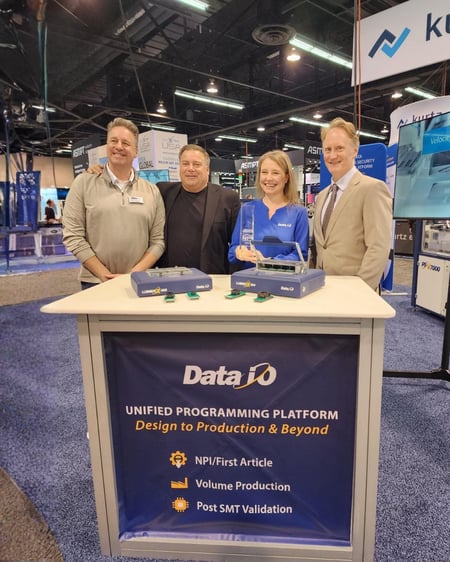
The highlight of the show came during the Circuits Assembly NPI Awards ceremony, where Data I/O was honored with the 2026 NPI Award in the Breakthrough in Electronics category for the LumenX2 platform. The award was presented by Mike Buetow, President of the PCEA (Printed Circuit Engineering Association), and accepted by our team at the show.
Apex Expo NPI Award 01

 (Pictured left to right: Monty Reagan, William Wentworth, Jennifer Higgins, and Mike Buetow, President of the PCEA (Printed Circuit Engineering Association), who presented Data I/O with the recognition at APEX Expo in Anaheim.) 


This recognition is an important validation of what the LumenX2 platform represents: next-generation programming performance designed for today’s most complex device requirements. The platform supports UFS, eMMC, microcontrollers, and secure elements, delivering fast verify speeds and tool-less changeovers that help manufacturers improve quality and reduce cost.

Read the full press release: Data I/O’s LumenX2 Platform Earns 2026 NPI Award for Breakthrough in Electronics Programming

Unified Programming Platform on Display

Throughout the four-day show, visitors experienced the full breadth of our unified programming platform, firsthand how the same programming environment carries validated jobs from engineering and NPI directly into high-volume production without requalification.

Solutions on display included:

  • LumenX2-M4: Next-generation manual programmer with expanded device support and faster programming performance

  • LumenX-M8: Award-winning manual programmer for design and NPI

  • FlashCORE III-M4: Trusted performance and scalability for NPI and preproduction workflows

  • PSV Family: High-speed automated programming systems for volume production, including the PSV7000, delivering flexibility and scalability ideal for programming high-density UFS memory and PSV5000, ideal for low to medium volume applications.

  • ConneX: Software for MES integration, traceability, and process analytics

The conversations at the booth reflected a market in motion. As Bill noted in his interview with What’s New in Electronics, the quality of engagement at the show was higher than ever:

“The conversations have been much more meaningful. You can tell the climate’s changed a little bit, and people are investing again.”


CEO Bill Wentworth on Growth, AI, and What’s Next

On day two of the show, Bill Wentworth sat down with Cliff Saunders of What’s New in Electronics for a candid conversation about Data I/O’s transformation, the broader market climate, and what manufacturers can expect from us in the year ahead.

Bill shared that 2025 was a year of deliberate investment, even when the market slowed. “When things aren’t that busy, you can think through decisions, try them out, and not have a negative effect on the business,” he explained.

That investment extended to internal operations, including a significant push into AI-assisted software development that has accelerated bug resolution and improved productivity across the engineering team.

On the business model side, Bill previewed new service offerings expected to roll out in the coming months, including CapEx-based programming models and contractual revenue structures that give customers greater flexibility.

“That’s always been the game plan: CapEx, services, and programming at test. Those are the three major intersection points for data provisioning,” he said. His outlook for 2026: “This is the year for return to growth. I’m seeing clear line of sight to that.”


Extending the Unified Programming Platform into Security Provisioning

One of the most significant conversations happening at the show and across the industry is how to build security into electronic products from the earliest stages of design, rather than treating it as an afterthought in production.

Our recently announced collaboration with IAR, the global leader in embedded development software tools, directly addresses this need. By combining IAR’s expertise in embedded security definition with Data I/O’s proven semiconductor preprogramming technology, the two companies are delivering a seamless workflow that extends secure provisioning from embedded design all the way through mass production manufacturing.

This integration enables OEMs worldwide to:

  • Design security in from the start with the IAR toolchain, then transfer securely into manufacturing on Data I/O manual and automated systems
  • Move production anywhere in the world securely, with consistent security provisioning across global manufacturing sites
  • Reduce development time through combined algorithm libraries that accelerate device support
  • Maintain complete traceability with ConneX software for device-level tracking throughout the entire security provisioning process

As government regulations and industry standards increasingly mandate robust security measures for electronic products, this partnership fills a critical gap in the unified programming platform story, closing the loop between embedded design and production in a way that minimizes exposure to threat actors and protects intellectual property at every step.


ConneX and the Road Ahead

Conversations at the show also generated real excitement around upcoming developments in our ConneX software platform. ConneX is the connective tissue of the unified programming platform, integrating with factory MES systems to enable real-time monitoring, job management, and end-to-end traceability across every stage of the supply chain.

We’re not ready to share all the details just yet, but a meaningful ConneX release is on the horizon, one that will bring deeper analytics, improved integration capabilities, and enhanced support for the security provisioning workflows we’re building with IAR. Stay tuned.


Thank You, Anaheim

APEX Expo 2026 reinforced something we already believe: the manufacturers who invest in a unified programming platform, one that connects NPI to production, design to security provisioning, and manual to automated workflows, are the ones best positioned to compete in a fast-moving global market.

Thank you to everyone who stopped by, asked sharp questions, and helped make this one of our most engaging shows yet. The energy we felt in Anaheim is driving everything we’re building for the months ahead.

We’d love to continue the conversation.


Ready to See the Unified Programming Platform in Action?

Ready to see the unified programming platform in action? Connect with our team to schedule a demo or consultation and discover how a unified strategy can power your next product launch.

 

Read More
Unlocking Efficiency: The Strategic Value of Offline Programming

Unlocking Efficiency: The Strategic Value of Offline Programming

In electronics manufacturing, speed, quality, and flexibility aren’t just goals; they're essential. As devices become more complex and firmware grows, traditional programming methods are being re-evaluated. One such evolution is the move to an offline programming strategy that’s helping manufacturers around the world overcome bottlenecks and drive efficiency.

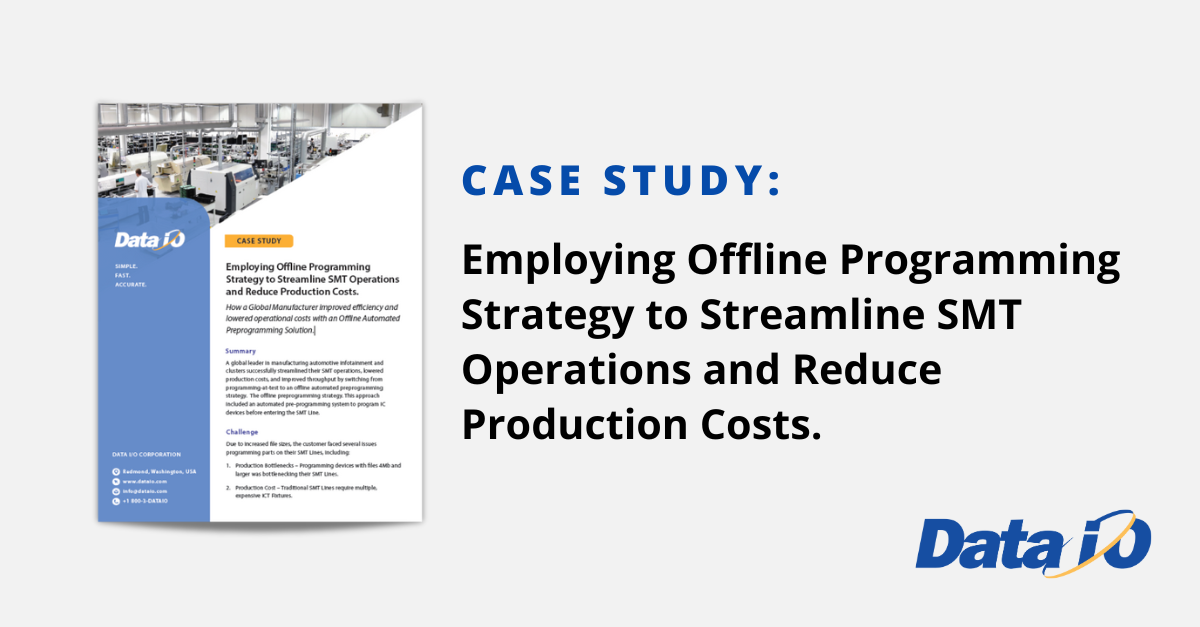
A new case study from a global automotive technology leader shows how shifting from in-circuit test (ICT) programming to Data I/O’s PSV7000 automated offline system eliminated production bottlenecks, enhanced programming reliability, and increased flexibility. You can explore the full case study here.


The Challenge with Onboard Programming

Programming at the ICT or functional test stage has been common in electronics assembly for years, but it's often an unseen source of inefficiency. As firmware sizes grow and security requirements increase, the time required to program a device can exceed the pace of the production line.

This challenge is especially pronounced in industries such as automotive, where traceability, quality, and programming precision are non-negotiable. Delays or failures at the programming stage can result in significant production downtime and inconsistent quality.


Inline vs Offline Programming: A Strategic Choice

Choosing between inline (in-system) and offline programming is not just a technical preference; it’s a strategic decision with operational consequences. Inline programming directly ties programming time to production cycle time. As programming tasks grow more complex, they can throttle throughput.

Offline programming removes this bottleneck. It allows manufacturers to program devices in parallel to production line operations, minimizing downtime and ensuring only pre-validated, programmed devices reach the assembly line. This strengthens quality control and supports scalability.

As Tan Beng Chye notes in Circuit’s Assembly "Programming In-System versus Offline," “ISP tends to extend the test cycle time by up to 200 percent, depending on the size of the code and the interface used. Offline programming eliminates programming from the test process and improves throughput.”


The Role of Automation

Offline programming becomes even more powerful when paired with automated systems like Data I/O’s PSV7000. For the OEM featured in the case study, automation introduced a new level of repeatability, throughput, and precision. It reduced operator error, accelerated production speed, and allowed the company to consolidate programming across multiple product lines with a unified job setup.


Manufacturing Execution Systems and Traceability

Offline programming strategies align well with modern manufacturing execution systems (MES). A strong MES doesn’t just provide traceability—it connects programming with broader manufacturing data. This is critical when validating firmware versions, serializing devices, and ensuring consistent outcomes across production locations.

When integrated with a solution like Data I/O’s ConneX, manufacturers gain real-time visibility into programming job status, analytics, and quality metrics. This integration supports faster root-cause analysis, compliance reporting, and continuous improvement.

When integrated with a solution like Data I/O’s ConneX, manufacturers gain real-time visibility into programming job status, analytics, and quality metrics. This integration supports faster root-cause analysis, compliance reporting, and continuous improvement.


Scalability Without Compromise

What makes the unified programming strategy so powerful is its ability to scale without disruption. A single programming job, validated during NPI, can be used across manual programmers like the LumenX-M8 or FlashCORE III-M4 and scaled seamlessly into automated PSV systems.

This consistency reduces requalification, eliminates duplicate engineering effort, and shortens time-to-market. For organizations managing global production networks or distributed supply chains, a unified programming strategy is a clear competitive advantage.


Access the Full Case Study

To see how one automotive technology leader achieved these results using the PSV7000, download the full case study here.

Learn how the switch to offline programming created new opportunities for efficiency, flexibility, and quality improvement in a high-demand environment.


Case Study Offline Programming Strategy


Read More
Productronica 2025: Programming Innovation on Display

Productronica 2025: Programming Innovation on Display

Reflecting on an Industry Milestone

Productronica 2025 marked another pivotal moment for the global electronics manufacturing community. For Data I/O, it was a celebration of innovation, partnership, and progress. From showcasing our latest solutions at booth A2-205 to winning one prestigious awards, the event underscored our ongoing leadership in device programming and preprogrammed supply chain enablement. 

As William (Bill) Wentworth, President and CEO of Data I/O, shared,

“Winning the 2025 Global Technology Award for LumenX2 is an important validation of how critical next-generation programming technology has become for our industry. With the LumenX2 platform we’re helping our customers improve quality, reduce cost and compete in a fast-moving global market.” 


Live at Booth A2-205: Unified Programming Platform Innovations On Display 

Throughout the show, visitors experienced firsthand the power of our Unified Programming Platform and how they can benefit from the same programming platform in design/NPI with a seamless transition into production.  Live demos included: 

  • NEW LumenX2-M4:  Industry unveiling of Data I/O’s next generation LumenX programming platform providing more power and pins and enabling broader support of device [can you link this to the PR?]

  • LumenX-M8: Our refreshed manual programmer attracted strong attention for its compact footprint, intuitive design, and seamless compatibility with automated PSV systems.

  • FlashCORE III-M4: Highlighted as a trusted solution for NPI and preproduction workflows.

  • PSV7000: Demonstrated high-speed automation, up to 2,000 parts/hour, with fast changeovers and scalable socket capacity. 

  • PSV5000: Provided a closer look at cost-effective automation for growing production needs. 


All systems emphasized our unified approach, validating programming jobs once and scaling them globally with consistent quality. 


Award-Winning Technology: LumenX2 Shines at Productronica 

We were honored to accept the Global Technology Award (Programming Category) for the LumenX2 platform and LumenX2-M4 manual programmer during the show. This recognition highlights our investment in platform scalability and our ability to address today’s most complex device programming requirements, including support for UFS, eMMC, microcontrollers, and secure elements with blazing fast verify speeds and tool-less changeovers. 

Earlier in the season, the LumenX-M8 earned the Mexico Technology Award at the SMTA Guadalajara Expo & Tech Forum in September, further recognizing its importance in helping customers streamline NPI and scale into automated production. Most recently, the LumenX-M8 was also awarded the 2025 Step-by-Step Excellence Award at NEPCON Shenzhen in October, honoring its innovation, ease of use, and contribution to engineering productivity. 


Engaging with Customers and Partners 

According to Monty Reagan in his interview with WNIE,

"The traffic here has been very good. We’ve had existing customers come by that are seeing the new products say, ‘yes, that fills a gap."

The booth buzzed with conversations from longtime customers and new prospects alike. Many visitors shared how their product roadmaps are shifting, and they’re seeking scalable solutions to support product diversification and global deployment. Our growing network of technology partners, many of whom spent significant time at our booth, helped reinforce that we’re supporting the complete lifecycle of preprogrammed parts. 


Leadership Vision: Building for Today and Tomorrow 

In a compelling interview with Global SMT TV, Bill Wentworth and Monty Reagan discussed how Data I/O is investing to bridge industry gaps: 

  • Scalable Automation: Addressing needs of mid-tier manufacturers with flexible, affordable tabletop automation. 

  • Embedded Solutions: Expanding capabilities by embedding programming into final test systems. 

  • Service and Capital Equipment Strategy: Offering programming as a service for customers not ready to invest in capex. 

Bill shared,

“We’re filling the gaps that matter, whether it’s light manufacturing in the U.S. and Europe or embedding programming in test systems. Our customers want flexibility, and we’re delivering it.” 


Customer-Centric to the Core 

As Monty noted,

“We’ve revamped our service organization and are adding tools to give customers better visibility to keep those systems alive and maximize the efficiencies of the equipment.” 

Our Unified Programming Platform ensures customers can confidently design products with the assurance they’ll scale seamlessly into production anywhere in the world. This lifecycle commitment is what’s made Data I/O a trusted partner for decades. 


The Road Ahead 

Productronica 2025 confirmed what we already know: innovation never stops. As we look to 2026, we remain focused on delivering programming solutions that keep pace with device complexity, accelerate time-to-market, and protect customer investments. 

Thank you to everyone who visited our booth, shared feedback, and helped make this year’s show a success. 


Want to see what’s next? 

Schedule a follow-up demo or consultation with our team and discover how a unified programming strategy can power your next product launch. 
 

Read More
Unified Programming Strategy: Simplify, Scale, and Succeed from Design to Production

Unified Programming Strategy: Simplify, Scale, and Succeed from Design to Production

Why Unified Programming Matters

Electronics manufacturing is more complex than ever. As devices become smarter and more connected, programming requirements are growing in volume, complexity, and security. For OEMs and manufacturers in automotive, medical devices, industrial controls, wireless, and consumer electronics, managing programming across design, NPI, and production is increasingly challenging.

A Unified Programming Strategy solves this by standardizing how programming is handled across every stage of the product lifecycle, using one integrated platform. It eliminates redundant effort, reduces risk, and speeds up time-to-market.


What is a Unified Programming Strategy?

A Unified Programming Strategy uses a single ecosystem of hardware, software, and job files across design, new product introduction (NPI), and high-volume production. Instead of separate systems for early-stage validation and factory programming, everything is aligned from day one.

Key components of the strategy include:

  • FlashCORE III-M4 and LumenX-M8 for design and NPI
  • PSV7000, PSV5000, and PSV3500 for automated volume production
  • ConneX for MES connectivity, traceability, and process analytics


Who Should Use a Unified Programming Strategy

A Unified Programming Strategy is best suited for companies seeking to improve quality, efficiency, and time-to-market by eliminating fragmentation in their programming processes. It’s particularly valuable for OEMs and manufacturers managing high-mix production or global operations. In-house engineering teams benefit from job file consistency across design validation and production. Companies with design operations in one region and production in another can seamlessly transfer validated programming jobs without rework. EMS providers and programming centers also benefit from compatibility across all job stages, reducing duplication and increasing customer satisfaction.


Common Challenges a Unified Strategy Solves

Manufacturers often face technical and operational hurdles when programming workflows are disjointed. For example, using different programming platforms for NPI and production often leads to checksum mismatches and costly requalification efforts. Recreating programming jobs manually introduces human error, causing delays and inconsistencies. Outsourced or fragmented programming can result in quality issues due to lack of process alignment. These gaps also disrupt just-in-time manufacturing models when preprogrammed parts arrive late or unvalidated. A Unified Programming Strategy addresses these problems by using a single programming job, algorithm, and adapter ecosystem across every phase.


The Benefits of a Unified Programming Strategy

Implementing a unified approach delivers clear operational and business advantages. It enables a streamlined NPI process where programming jobs are validated once and carried through to high-volume production without modification. This reduces engineering labor, eliminates duplication, and ensures consistent outcomes. Manufacturers experience faster time-to-market because delays caused by requalification or job recreation are eliminated. Costs decrease as fewer errors occur and teams spend less time managing transitions.

According to research published in Information and Management, companies that adopt digital transformation strategies, including standardization and process integration, experience measurable gains in production efficiency, operational agility, and cost savings (Wang et al., 2024).

Real-world use further reinforces these benefits. For example, in the blog Optimizing the NPI Process with a Unified Programming Platform, one OEM reduced requalification time and achieved consistent programming results from engineering through production by adopting a unified programming platform.

With ConneX software, traceability is built in, giving engineering and quality teams access to job-level data across the supply chain. And as production ramps, the same validated programming jobs can scale effortlessly from manual validation to high-volume PSV automation.


How Data I/O Enables a Unified Programming Strategy

Data I/O’s programming solutions are purpose-built to support a unified strategy from start to finish. Our programming technology, FlashCORE III and LumenX, is at the core of our solutions. Our manual and automated programming systems use the same programming technology. The FlashCORE III-M4 and LumenX-M8 manual programmers empower engineering teams to validate jobs at the design stage with the same programming platform technology used in production. For automation, the PSV family of programmers (PSV7000, PSV5000, PSV3500) offers unmatched scalability, performance, and socket density to meet any volume need. ConneX software integrates with factory MES systems, enabling traceability, real-time monitoring, and job management. With global service, device support, and annual support programs, Data I/O ensures your investment is protected and future-ready.


Is Your Programming Strategy Unified?

Use this checklist to evaluate if your current device programming process supports a unified approach from design to production.

  • Are your design/NPI and production teams using the same programming platform?
    Mismatched tools increase job recreation time and risk of checksum errors.
  • Can you validate a job once and use it throughout the product lifecycle?
    Reusing validated jobs across stages saves time and ensures consistency.
  • Do you rely on manual job recreation when transferring to production?
    Manual recreation introduces unnecessary risk. Unified job files eliminate this.
  • Is your programming solution scalable across low to high volumes?
    A unified platform should support both desktop validation and automated production.
  • Do you have built-in traceability and MES integration?
    Tools like ConneX enable real-time tracking, analytics, and job-level traceability.
  • Can you support global production without changing adapters, algorithms, or job files?
    Unified systems reduce requalification and enable seamless global manufacturing.
  • Have you eliminated rework caused by programming inconsistencies?
    Unified programming reduces errors, improves first-pass yield, and ensures quality.

Take the Next Step

If you're ready to optimize your programming process, streamline your supply chain, and improve production outcomes, it’s time to unify.

Start your unified strategy today. Schedule a consultation or demo with our team.


Reference:
Wang, D., Wang, H., Deng, W., & Wu, Y. (2024). Digital transformation and production efficiency: Evidence from manufacturing firms. Information and Management, 61(3). https://www.sciencedirect.com/science/article/pii/S1059056024000467

Read More