Insights Blog

Posts about:

NPI

Energy, Engagement and Innovation Data I/O at IPC APEX 2025

Energy, Engagement & Innovation at IPC APEX 2025

The IPC APEX Expo 2025 was one for the books. From live demos to deep conversations about production efficiency and programming innovation, this year’s show was by far the most engaging Data I/O has participated in for quite some time.

A sincere thank you to all who stopped by Booth #2723. Whether you saw our unified programming platform in action, watched a demo, or connected with the team, your interest and energy were truly inspiring. We’re carrying that momentum forward as we continue evolving our offerings to support OEMs and electronics manufacturers better better.


Refreshed Manual Programmers Take Center Stage

This year’s show marked the debut of our refreshed manual programmers, designed to support preprogramming needs from design through volume production. Engineered for flexibility, accuracy, and seamless integration, these updates make it easier than ever to validate and transfer programming jobs from NPI into high-volume manufacturing.

When paired with our PSV family of automated systems, these refreshed solutions offer a unified platform experience, streamlining workflows and improving consistency across the entire production lifecycle.


Interview with WNIE: Strategy Meets Innovation

We were thrilled to have Monty Reagan, VP of Global Sales & Marketing, sit down with What’s New in Electronics (WNIE) during the show. In this short interview, Monty shared how Data I/O is streamlining the device programming process—from early design and NPI through production, QC, and repair.

Monty discussed how our unified platform strategy helps manufacturers simplify complex programming challenges and stay competitive in a rapidly evolving electronics landscape. He also shared insights into how we’re leveraging automation and AI to drive efficiency and innovation across the supply chain.


Driving Impact Through a Unified Programming Strategy

Throughout the week, attendees experienced how a unified programming platform can:

✅ Reduce errors with precise, reliable device programming
✅ Improve lead times by streamlining production workflows
✅ Enhance traceability and quality with a fully connected factory

With our integrated solutions—spanning from refreshed manual systems to production-ready PSV platforms—we’re helping electronics manufacturers streamline NPI, reduce delays, and optimize performance from the start.


Looking Ahead

The energy we experienced at IPC APEX 2025 is fueling new ideas and ongoing product development. We’re committed to building on this momentum and delivering even more value to our customers in the months ahead.

If you missed us at the show or want to continue the conversation, we’d love to connect.

Contact Our Sales Team


Read More
Optimizing the NPI Process with a Unified Programming Platform

Optimizing the NPI Process with a Unified Programming Platform

For OEMs, the New Product Introduction (NPI) process is critical in ensuring that new designs are ready for production. A key step in this process is programming the flash memory or microcontroller devices to validate that the firmware or software is correctly written. However, inconsistencies can arise when different programming platforms are used during design, NPI, and production, leading to increased costs, delays, and quality issues.

A global manufacturer of computer products and accessories faced these exact challenges. Their NPI workflow relied on a different programming supplier for design, test, and validation before transitioning to a Data I/O automated programming system for volume production. This mismatch in platforms led to inefficiencies, requiring additional requalification time and increasing the risk of programming errors.

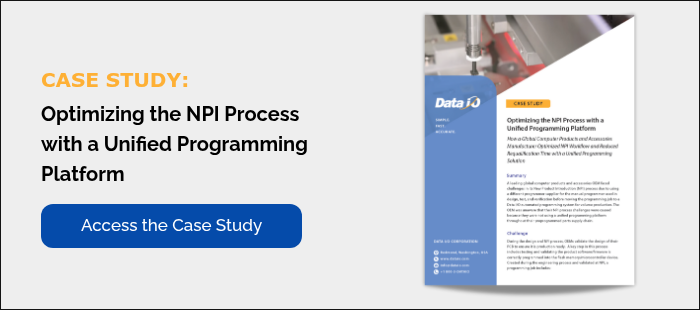
Download the full case study to see how this OEM overcame these challenges with a unified programming platform.


The Risks of Using Different Programming Platforms

Using different programming solutions during NPI and production creates several challenges:

  • Inconsistent Programming Results – Proprietary algorithms from different vendors can lead to mismatched checksums and failed verifications.
  • Increased Human Error – Recreating programming jobs from scratch for production increases the chance of mistakes.
  • Higher Costs – Different programming platforms require separate adapters, adding unnecessary expense.
  • Delays in Production – Algorithm requalification slows down the transition from NPI to volume manufacturing.

For manufacturers striving for efficiency, these challenges can disrupt timelines, add costs, and impact overall product quality.


A Unified Solution for Seamless NPI to Production

To address these inefficiencies, the OEM implemented Data I/O’s FlashCORE manual programmer for NPI, aligning it with their existing PSV3500 automated programming system used in volume production. This shift to a unified programming platform allowed them to:

  • Seamlessly transfer validated programming jobs from engineering to production.
  • Eliminate algorithm requalification between different programming suppliers.
  • Use shared socket adapters across design, NPI, and production phases.

By integrating a single programming platform from the start, the OEM optimized their NPI workflow and removed barriers to efficient production.


Measurable Results: Improved Efficiency and Quality

By adopting a unified programming platform, the OEM achieved:

  • Increased Efficiency – Reduced requalification and failure analysis time.
  • Improved Quality – Consistent programming results from engineering through production.
  • Supply Chain Optimization – Standardized programming across the entire product lifecycle.

This transformation enabled the manufacturer to accelerate their NPI process, reduce production delays, and improve overall manufacturing reliability.


Download the Full Case Study

Ready to streamline your NPI process and boost manufacturing efficiency?

Download the full case study to discover how a unified programming platform transformed a global OEM’s operations and how it can drive similar results for your business.


Read More