
In electronics manufacturing, speed, quality, and flexibility aren’t just goals; they're essential. As devices become more complex and firmware grows, traditional programming methods are being re-evaluated. One such evolution is the move to an offline programming strategy that’s helping manufacturers around the world overcome bottlenecks and drive efficiency.
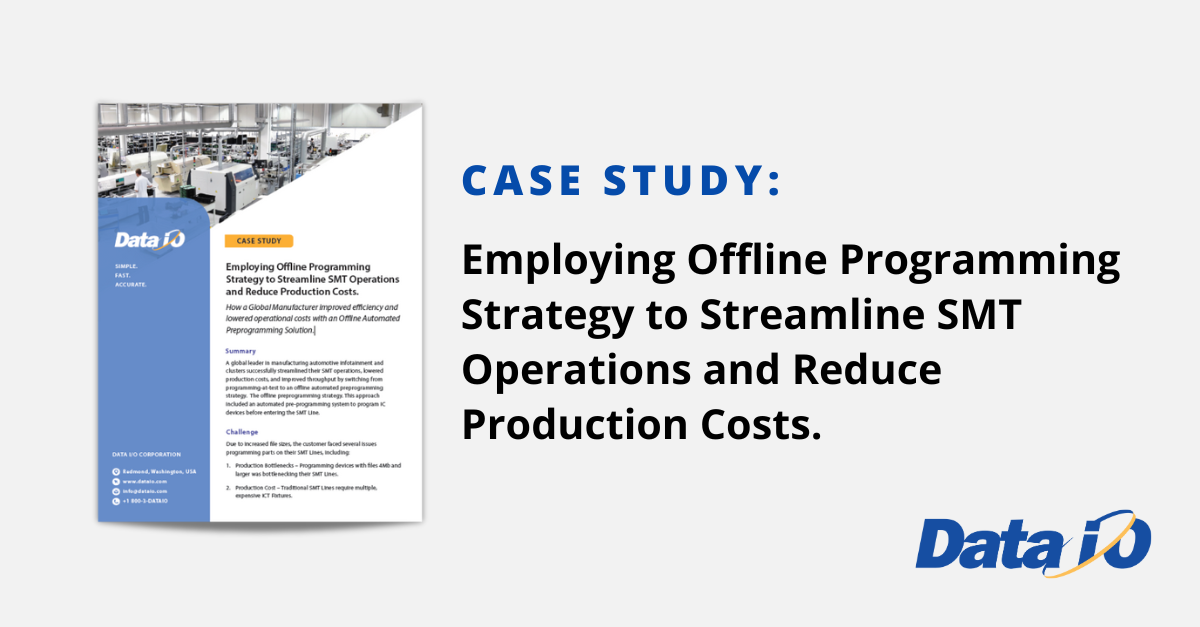
A new case study from a global automotive technology leader shows how shifting from in-circuit test (ICT) programming to Data I/O’s PSV7000 automated offline system eliminated production bottlenecks, enhanced programming reliability, and increased flexibility. You can explore the full case study here.
The Challenge with Onboard Programming
Programming at the ICT or functional test stage has been common in electronics assembly for years, but it's often an unseen source of inefficiency. As firmware sizes grow and security requirements increase, the time required to program a device can exceed the pace of the production line.
This challenge is especially pronounced in industries such as automotive, where traceability, quality, and programming precision are non-negotiable. Delays or failures at the programming stage can result in significant production downtime and inconsistent quality.
Inline vs Offline Programming: A Strategic Choice
Choosing between inline (in-system) and offline programming is not just a technical preference; it’s a strategic decision with operational consequences. Inline programming directly ties programming time to production cycle time. As programming tasks grow more complex, they can throttle throughput.
Offline programming removes this bottleneck. It allows manufacturers to program devices in parallel to production line operations, minimizing downtime and ensuring only pre-validated, programmed devices reach the assembly line. This strengthens quality control and supports scalability.
As Tan Beng Chye notes in Circuit’s Assembly "Programming In-System versus Offline," “ISP tends to extend the test cycle time by up to 200 percent, depending on the size of the code and the interface used. Offline programming eliminates programming from the test process and improves throughput.”
The Role of Automation
Offline programming becomes even more powerful when paired with automated systems like Data I/O’s PSV7000. For the OEM featured in the case study, automation introduced a new level of repeatability, throughput, and precision. It reduced operator error, accelerated production speed, and allowed the company to consolidate programming across multiple product lines with a unified job setup.
Manufacturing Execution Systems and Traceability
Offline programming strategies align well with modern manufacturing execution systems (MES). A strong MES doesn’t just provide traceability—it connects programming with broader manufacturing data. This is critical when validating firmware versions, serializing devices, and ensuring consistent outcomes across production locations.
When integrated with a solution like Data I/O’s ConneX, manufacturers gain real-time visibility into programming job status, analytics, and quality metrics. This integration supports faster root-cause analysis, compliance reporting, and continuous improvement.
When integrated with a solution like Data I/O’s ConneX, manufacturers gain real-time visibility into programming job status, analytics, and quality metrics. This integration supports faster root-cause analysis, compliance reporting, and continuous improvement.
Scalability Without Compromise
What makes the unified programming strategy so powerful is its ability to scale without disruption. A single programming job, validated during NPI, can be used across manual programmers like the LumenX-M8 or FlashCORE III-M4 and scaled seamlessly into automated PSV systems.
This consistency reduces requalification, eliminates duplicate engineering effort, and shortens time-to-market. For organizations managing global production networks or distributed supply chains, a unified programming strategy is a clear competitive advantage.
Access the Full Case Study
To see how one automotive technology leader achieved these results using the PSV7000, download the full case study here.
Learn how the switch to offline programming created new opportunities for efficiency, flexibility, and quality improvement in a high-demand environment.